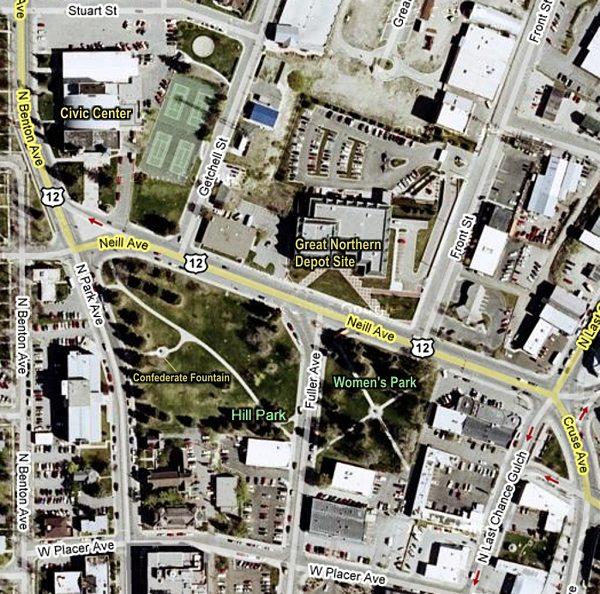
Including Hill Park, Women's Park
46°35'39.29"N
112° 2'26.02"W

1930s
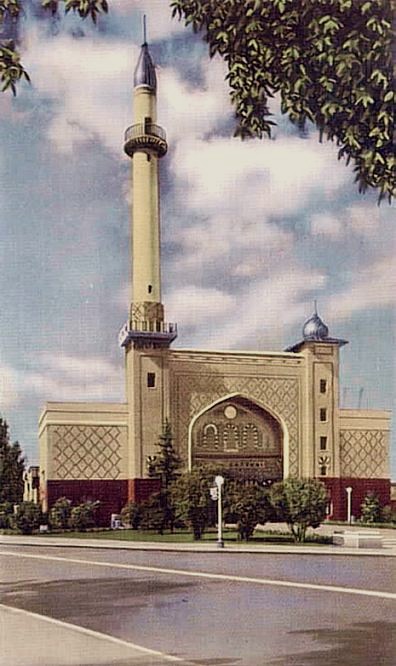
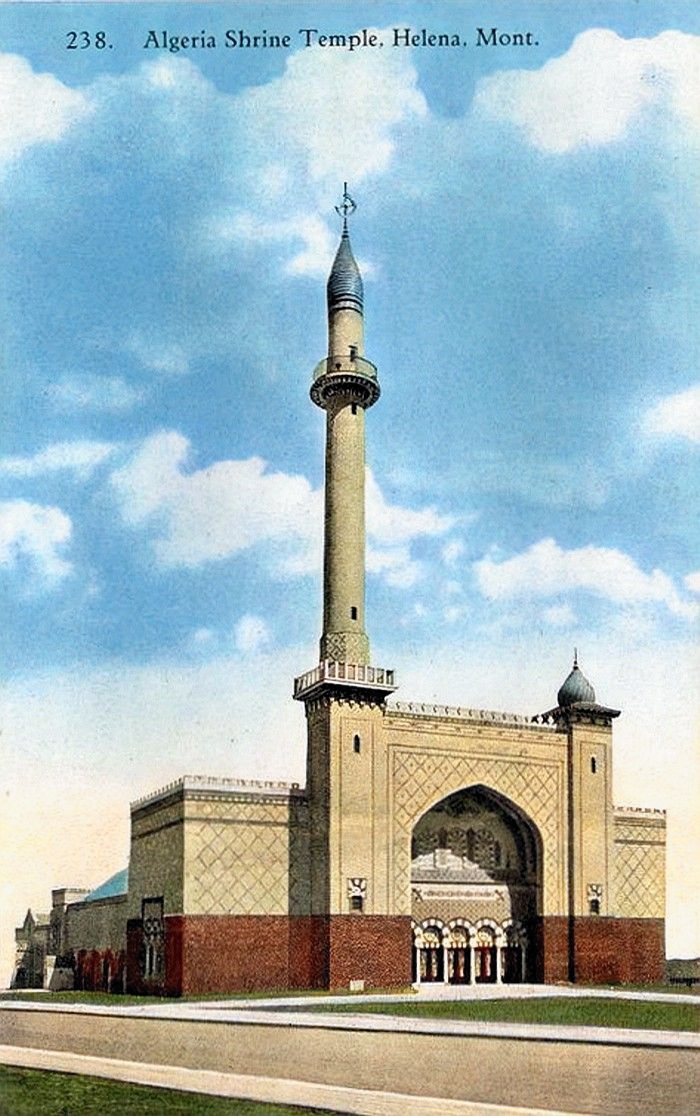
Tinted Postcard of the Algeria Shrine Temple
|
Built in
1920-21 as the headquarters of the Algeria
Shrine,
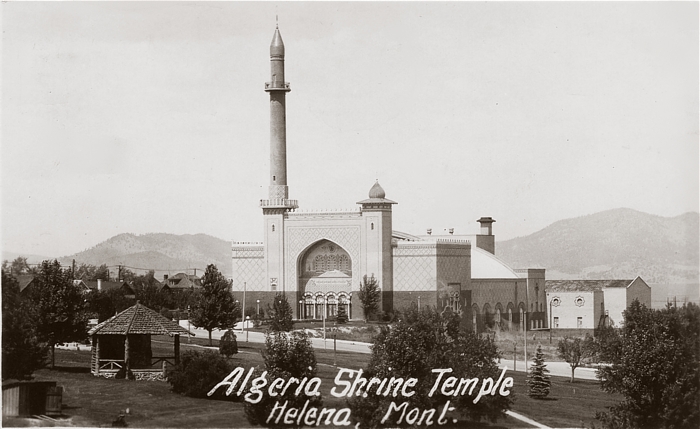
this remarkable Moorish Revival style building, with its towering
minaret, has long been a popular postcard and snapshot subject.
The building
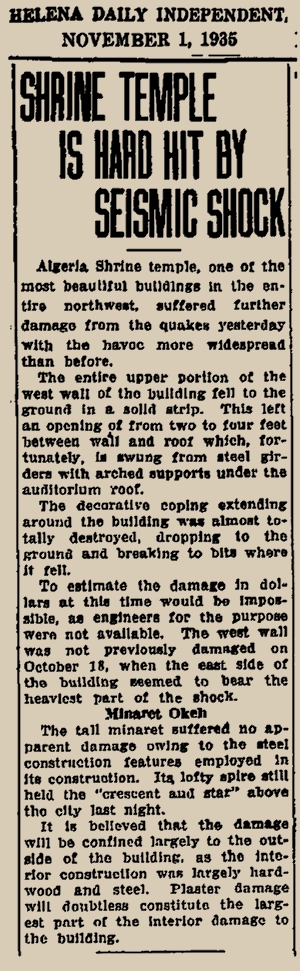
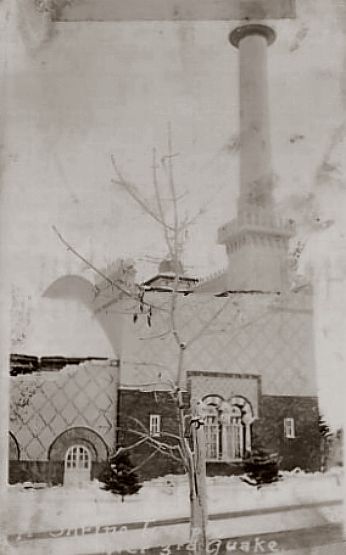
suffered substantial damage in the 1935 earthquakes, and the
City of Helena purchased it from the Shrine shortly thereafter.
It was the home of City offices until 1976, when they were removed
to the renovated 1904 Federal
Building. The police department operated from the Civic
Center for decades, and the fire department still has a staion
there.
For a detailed history of the Civic Center, download the 1987
National
Register of Historic Places nomination form ,
courtesy of the Montana Historical Society's Montana
History Wiki.
|
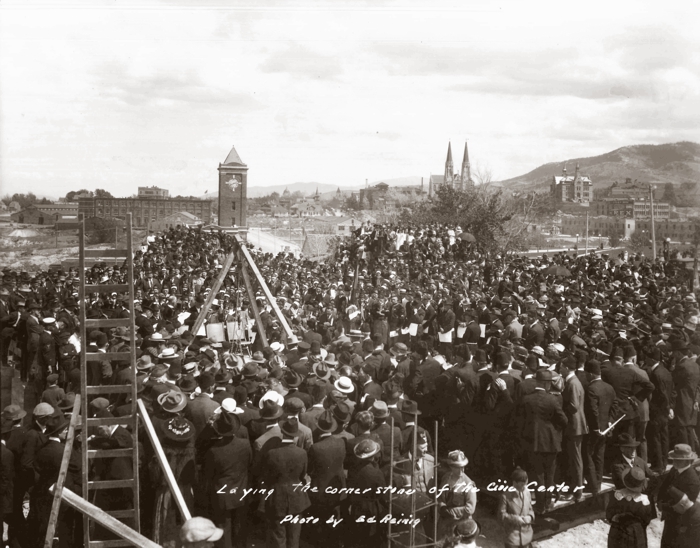
Algeria Shrine Cornerstone Ceremony
June 19, 1920
COURTESY OF KARLA SHERRY • CLICK ON IMAGE TO ENLARGE IN A NEW WINDOW
The
Algeria Shrine Temple Nearing Completion, 1921
Note scaffolding in front archway

COURTESY OF THE DAVID POOR COLLECTION
Detail
Showing Scaffolding

Dedication
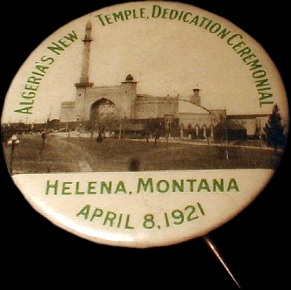
Ceremony Souvenir Button
Recent
Satellite Image of the Civic Center Area

Algeria
Shrine Temple from the Federal Building, probably 1924
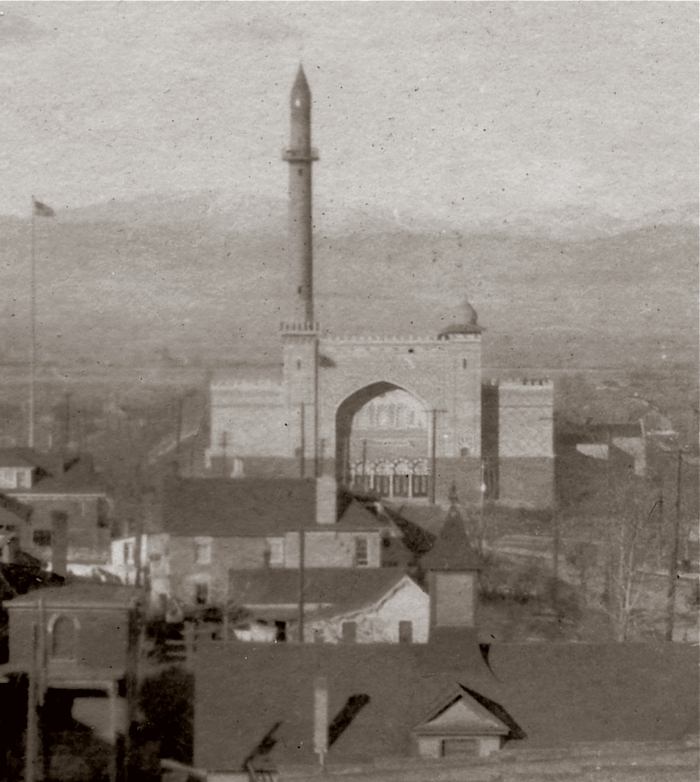
COLLECTION
OF KENNON BAIRD
Algeria
Shrine Temple and a Corner of Hill Park, 1920s

COURTESY
OF TOM KILMER
Intersection of Benton
Ave. and Neill Ave.
Algeria
Shrine Temple in Winter, 1920s
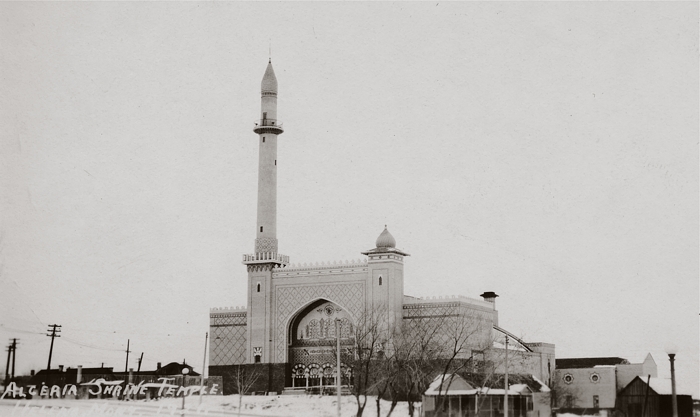
COLLECTION
OF KENNON BAIRD
Algeria
Shrine Temple, 1920s
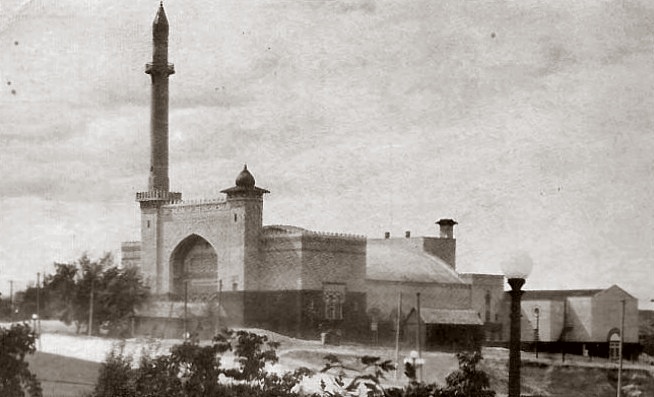
Algeria
Shine Temple & the Great Northern Depot from Women's Park, 1920s
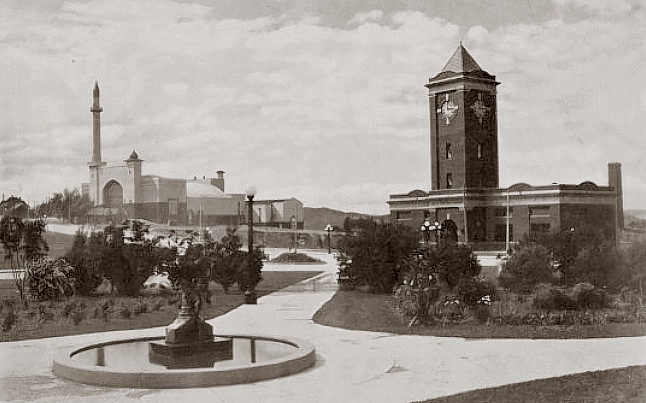
|
In 1938,
the Helena Chamber of Commerce briefly entertained plans to
build a log cabin history museum on the NE corner of Women's
Park. Helena women's clubs and other concerned women nixed the
location because construction would have changed the original
design of the park, which they felt would have been unfair to
the memory of women instrumental in making the park a possibility,
and would have displaced benches and fountains that had been
placed as memorials.
In May of
1939, a small museum opened in the west end of the Great Northern
Depot.
|
Algeria
Shrine Temple, ca. 1928
COURTESY
OF TOM MULVANEY •
CLICK ON IMAGE FOR A BIG VERSION IN A NEW WINDOW
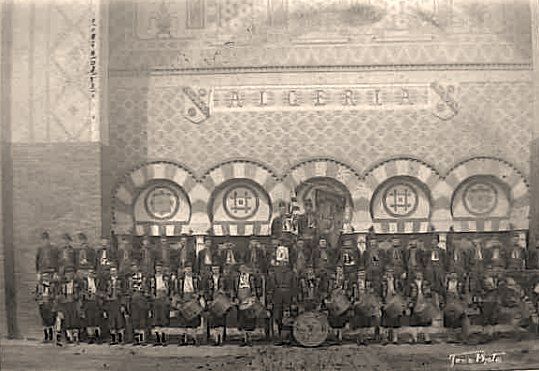
Algeria
Shrine Band in front of the Temple, 1920s
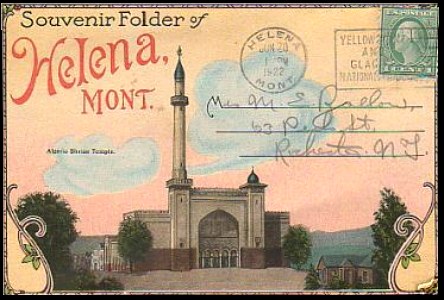
Souvenir
folder featuring the Algeria Shrine Temple, 1920s
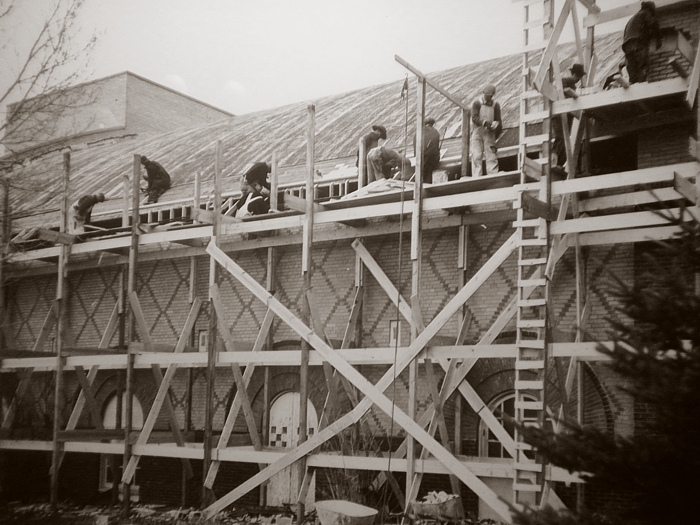
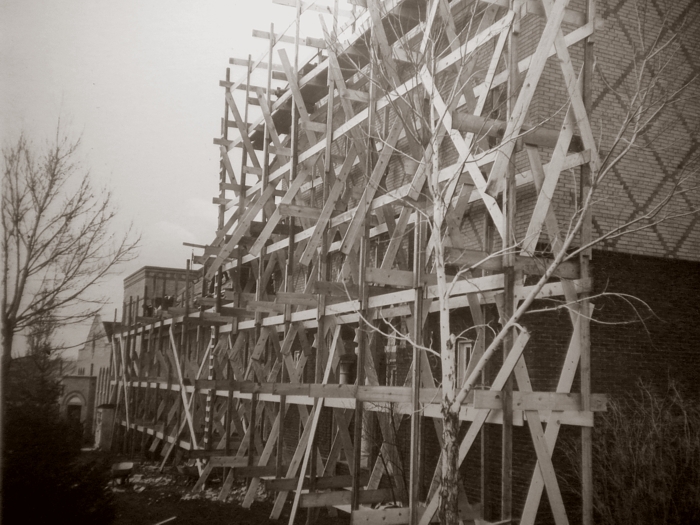
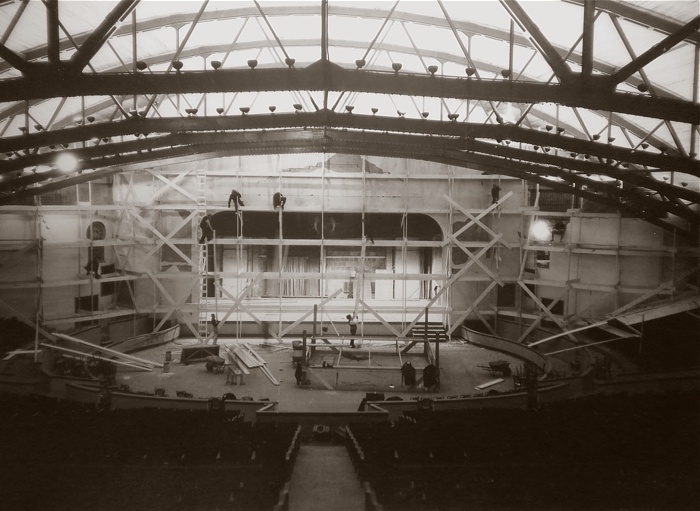
1935
Earthquake Damage

|
|
|
Both
photos show damage on the west side, along Park Ave.
There was similar damage on the east side, as well as
extensive cracking of interior plaster.
The
ballroom, on the north end of the building, apparently
was not extensively damaged; public events, including
fundraisers for building repair, were held there in
1936 and '37. Repairs on the Temple concluded in December
of 1937.
|
|
West
Side, Nov. 17 1935
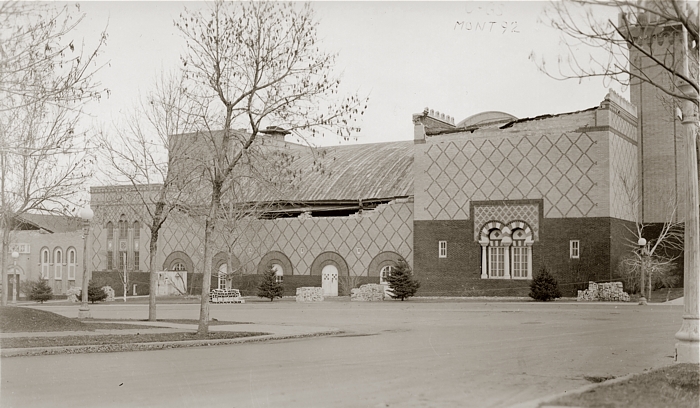
COURTESY
OF THE SEAN LOGAN COLLECTION • CLICK
ON IMAGE TO OPEN A BIG VERSION IN A NEW WINDOW
Looking
Northeast , Nov. 17 1935
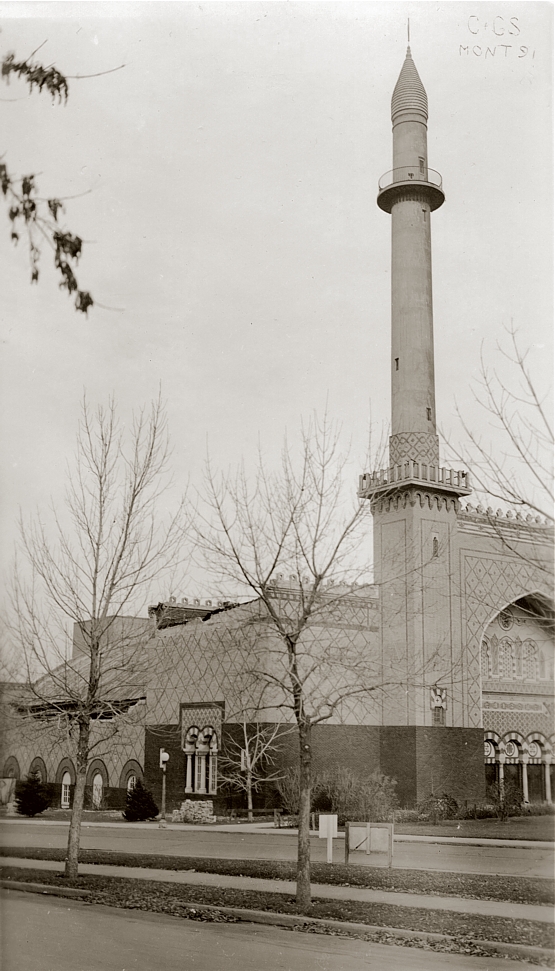
COURTESY
OF THE SEAN LOGAN COLLECTION • CLICK
ON IMAGE TO OPEN A BIG VERSION IN A NEW WINDOW
East
Side, Oct. 18 1935
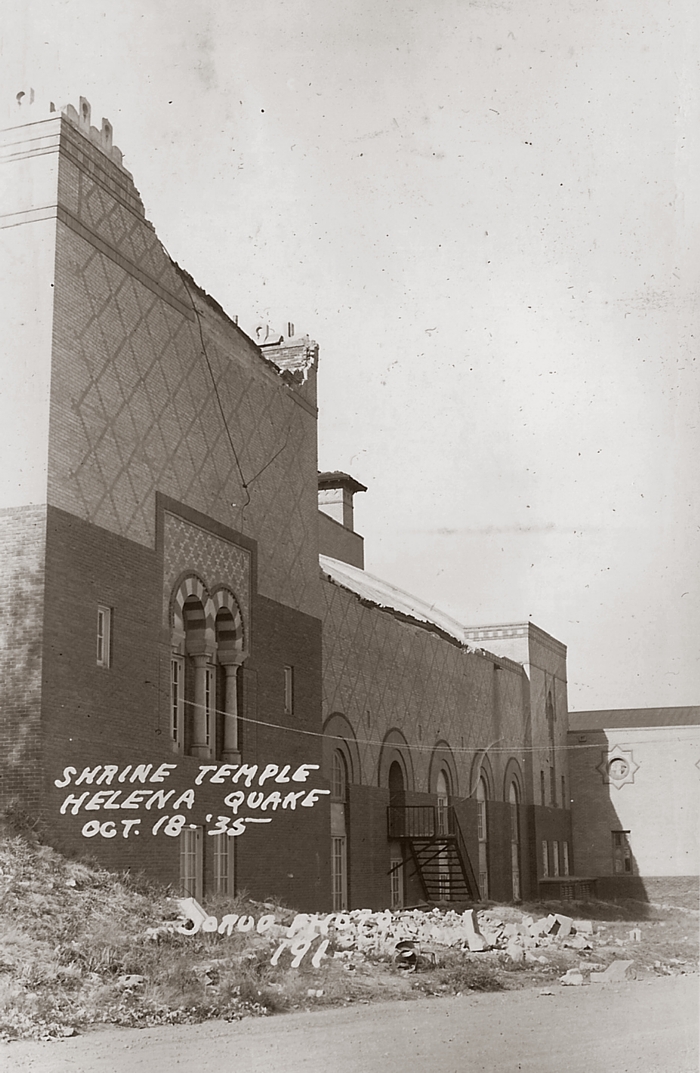
COURTESY
OF THE ANN AND JOHN FAY COLLECTION, VIA KALLY PORRINI
East
Side, Nov. 10 1935
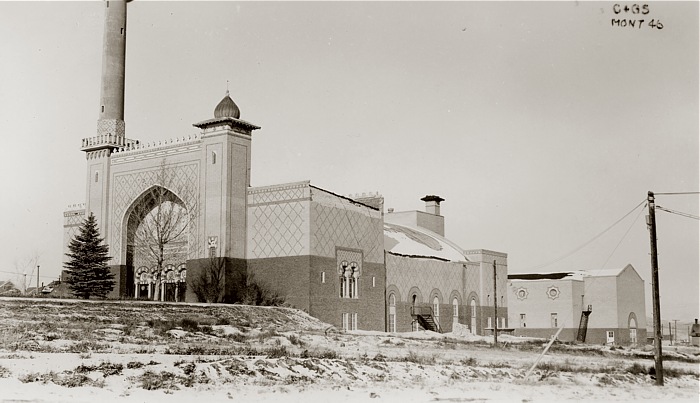
COURTESY
OF THE SEAN LOGAN COLLECTION • CLICK
ON IMAGE TO OPEN A BIG VERSION IN A NEW WINDOW
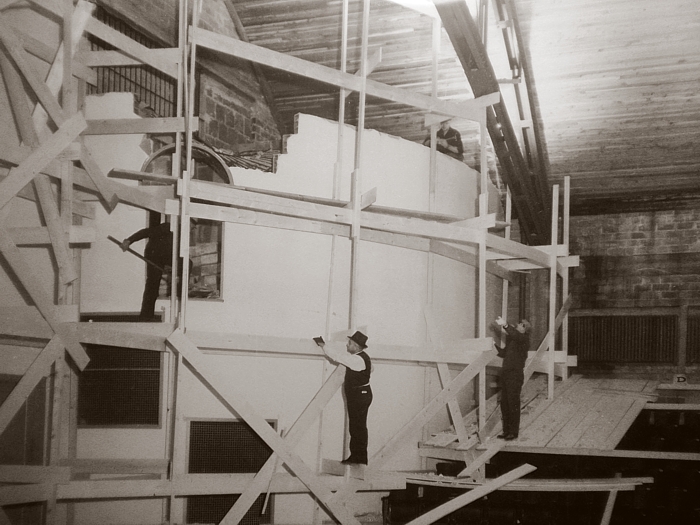
Undergoing
Repair
Four
Photos Courtesy of the Helena
Civic Center, via Kerry Brown
Special Thanks to Diane Stavnes
CLICK
ON IMAGE TO OPEN A BIG VERSION IN A NEW WINDOW
CLICK
ON IMAGE TO OPEN A BIG VERSION IN A NEW WINDOW
CLICK
ON IMAGE TO OPEN A BIG VERSION IN A NEW WINDOW
The
Wall Above the Auditorium Stage Required Additional Repair


CLICK
ON IMAGE TO OPEN A BIG VERSION IN A NEW WINDOW
The
Original Dome
1921
- 1938
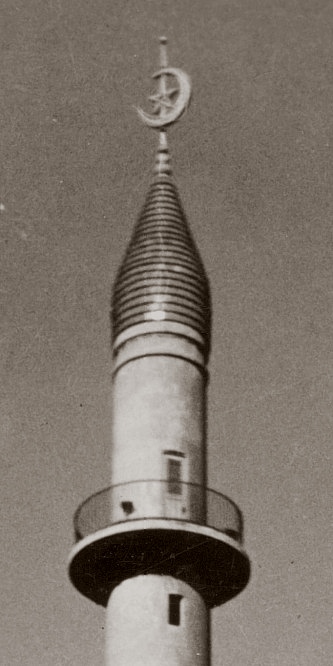
COLLECTION OF KENNON
BAIRD
| The
dome of the Algeria Shrine Temple minaret was originally covered
with blue terra cotta tiles, and topped by a metal crescent and
star motif. The City purchased the building following the 1935
earthquakes. |
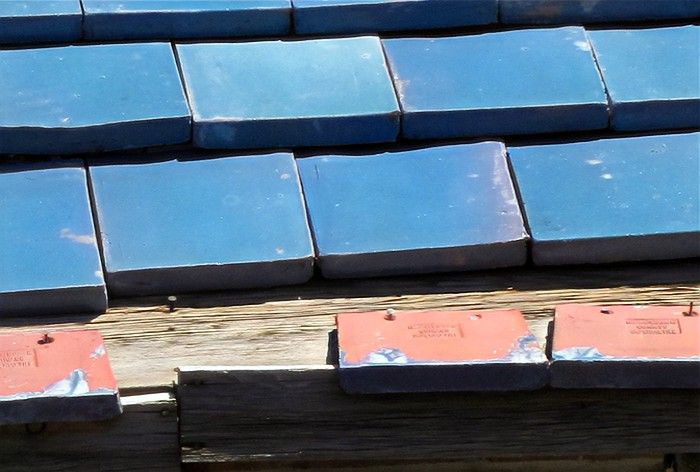
Original
Blue Terra Cotta Tiles Can Still Be Seen
AT THE
BASE OF THE SMALL ONION DOME

PHOTO
BY KENNON BAIRD
The tiles are
difficult to see from street level. Many layers of paint are visible
on the onion dome.
PHOTO
BY KENNON BAIRD
The
City of Helena Removed the Blue Tile Dome in 1938
Replaced with sheet copper dome in 1939 following protests
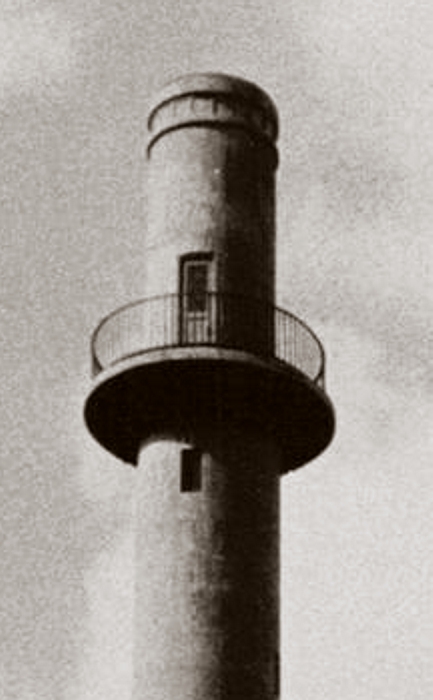
COURTESY
OF CAPT. SEAN LOGAN & THE HELENA FIRE DEPT.
FOR MORE HISTORIC HFD PHOTOS, CLICK
HERE!

COLLECTION
OF TED KIRKMEYER, COURTESY OF TOM
MULVANEY
COLORIZED AND ENHANCED PHOTOGRAPH
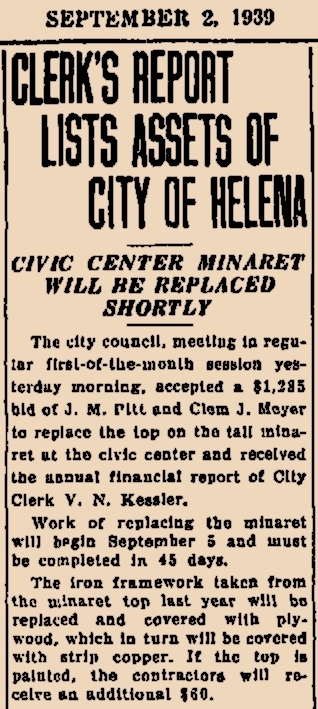
| Promotional
float for the Marlow Theatre, parked on Fuller Avenue, 1939. In
the background is the domeless Civic Center minaret. |
|
In
July of 1977, Entrepreneur Clem Meyer of Helena recalled to
an Independent Record reporter what covering the restored dome
with copper was like...
"It's
208 feet to the top," Meyer said. "I had to cut
the copper to fit like barrel staves, then carry it up the
stairs to the balcony." From there he climbed scaffolding
to the peak. "I used to be able to walk a 2 X 4 joist,"he
said. "Now I can't walk on a plank.
"DON'T GET OLD," he ordered with a rueful smile. |
|
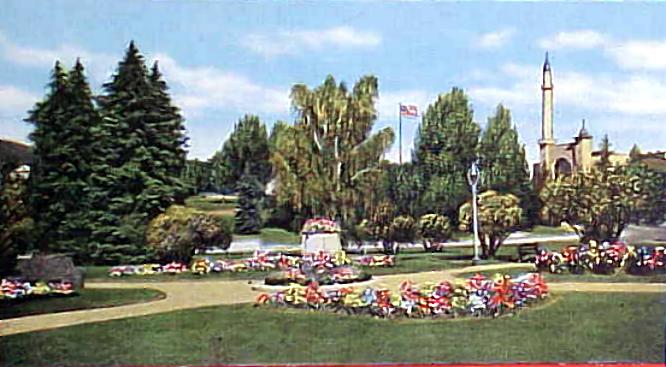
A
Pleasant 1940s Postcard
View
Civic
Center from Women's Park, 1940s
|
This from
the National Park Service's Women's
Progress Commemorative Commission Women's History Site Database
(pdf file):
Prior to
1905, the area that later became Women's Park was a spot were
women often stopped to rest on their way back to their west
side homes after shopping downtown. Rose bushes were informally
planted and benches placed in what became known as the
Women's Resting Place. In 1913, James and Mary Hill donated
the land to the City of Helena for the park. The property was
split in two with the construction of Fuller Avenue in 1918,
and the parks became known as Hill Park and Women's Park. The
Women's Park Association was formed during this period. They
held a benefit ball to raise funds to beautify the parks in
1916, and over the years dedicated additional benches and other
improvements.
|
Postcard
view from Hill Park, 1940s

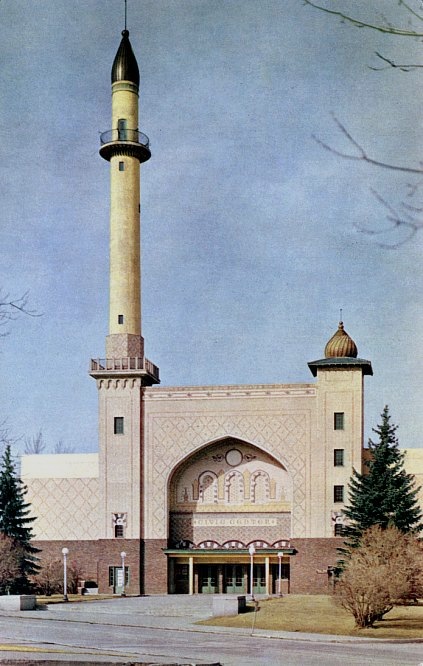
A late
1940's postcard view
COLLECTION
OF KENNON BAIRD
Civic
Center façade

A late-afternoon
view, before 1951
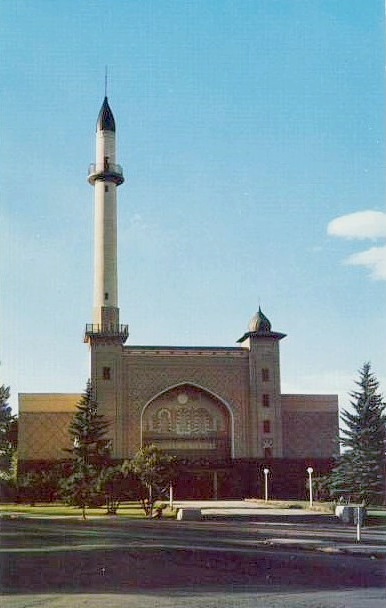
| We can date
this photo because we don't see the old silver bell which once
hung in the fire tower on display in front of the Civic Center.
It was placed there in 1951 (see it in the following photo). |
Civic
Center from Hill Park, ca.1954
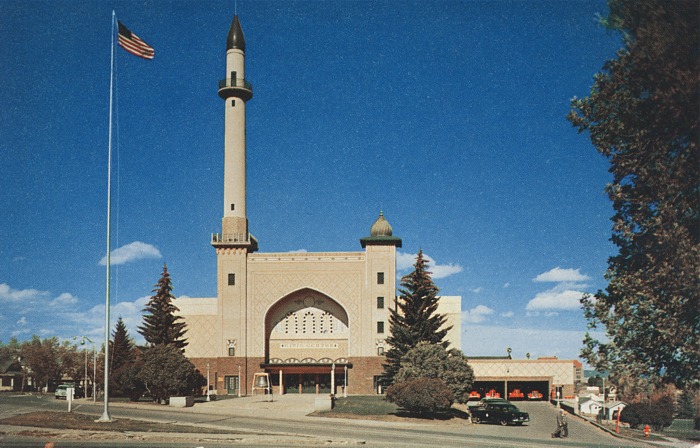
COLLECTION
OF KENNON BAIRD
Fire trucks at
the ready!
Bethlehem Scene, 1960

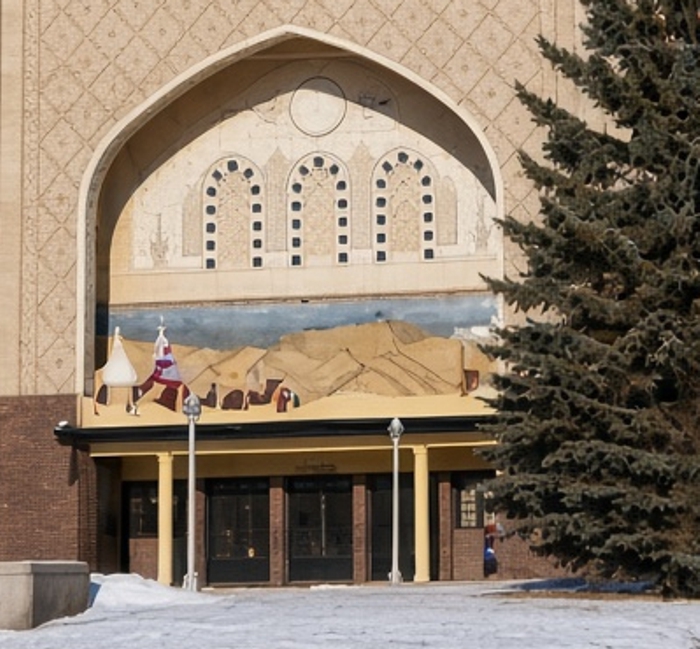
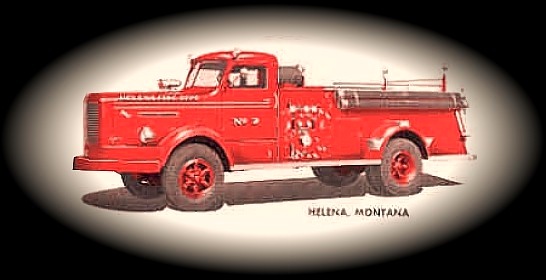
| 1954 Helena
fire truck, purchased from The Four Wheel Drive Auto Company of
Clintonville, Wisconsin. |
Park
Ave. and the Civic Center, 1957
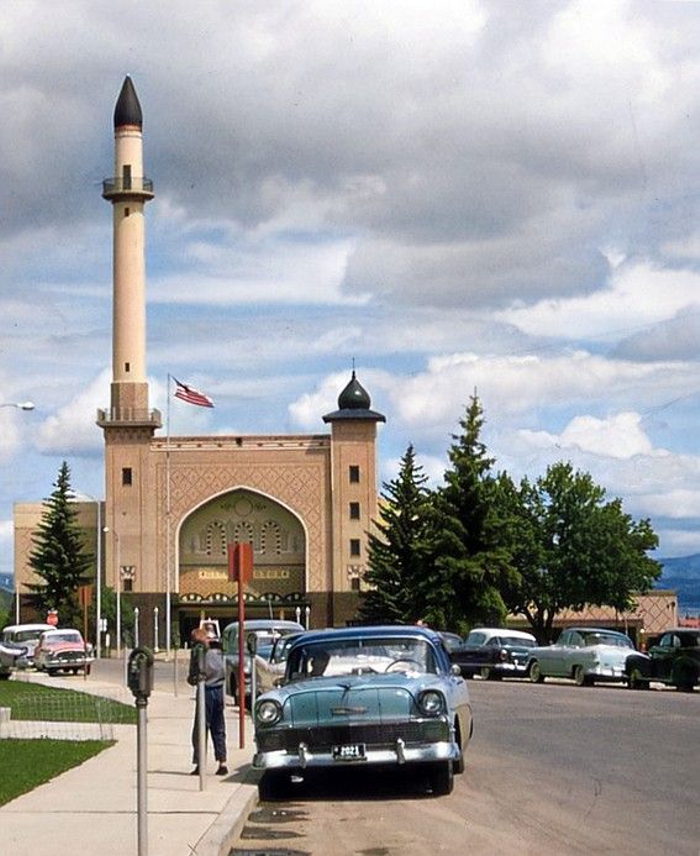
COLLECTION
OF KENNON BAIRD
View from Hill Park, 1970s

COURTESY OF RICHARD MORTIEAU
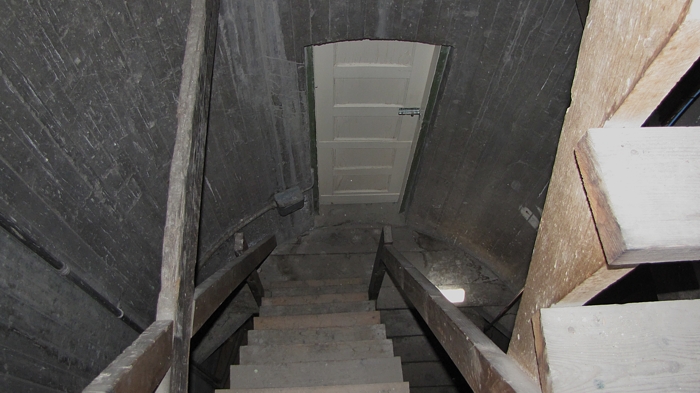
Inside
the Minaret, June 24 2009
PHOTO
BY KENNON BAIRD
|
The high
circular observation platform of the Civic Center minaret, just
below the dome, is reached by climbing wooden steps located
inside the structure. The steps are hung from horizontal timbers.
Pictured
above is the door leading out to the large square observation
platform at the base of the cylindrical minaret.
|

PHOTO
BY KENNON BAIRD
A view of the
steps, about halfway up the minaret.
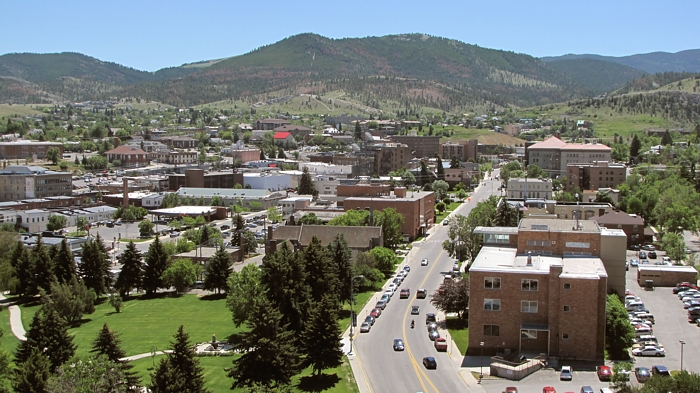
Downtown
from the Minaret, June 24 2009
PHOTO
BY KENNON BAIRD •
CLICK ON IMAGE FOR A BIG VIEW IN A NEW WINDOW
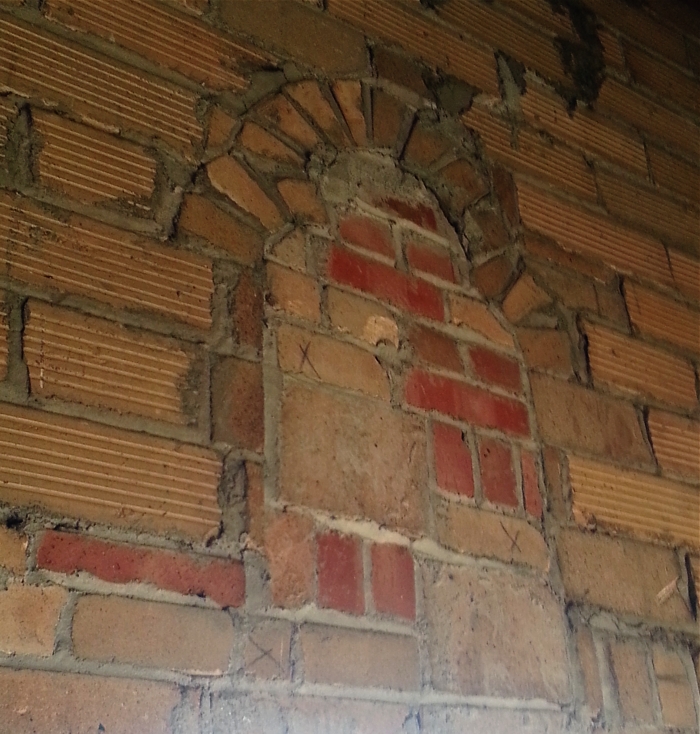
Inside
the East Tower, 2012
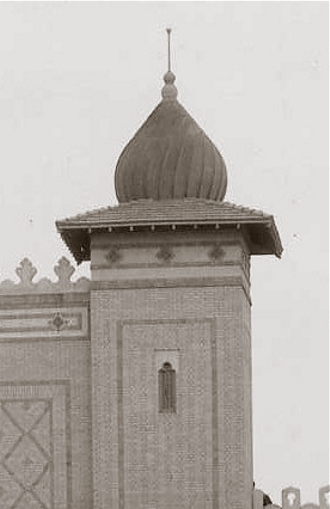
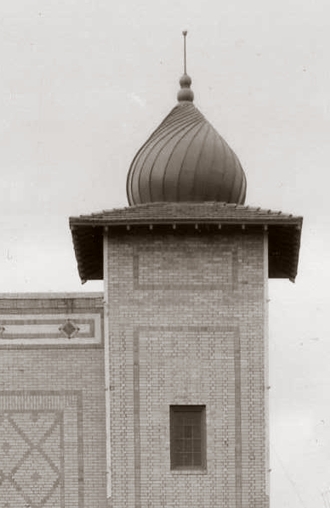
| As part of
the conversion of the Algeria Shrine Temple into City Hall after
the 1935 earthquakes, the fenestration on the south side of the
building was changed, primarily to create a Helena Fire Department
training facility. The east tower was substantially augmented,
with a narrow Moorish window being bricked up and three large
rectangular window openings added... |
Bricked-up
Moorish Window Seen from Inside the East Tower
COURTESY
OF SEAN LOGAN
|
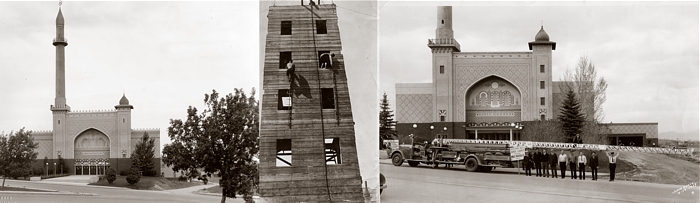
The new
windows, installed in the late 1930s, are removable from the
inside, allowing firemen to practice rappelling down the façade
of the building. The placement of the new windows mimics an
earlier wooden training wall which stood near the old fire house
on South Main.
The composite
image below shows the Algeria Shrine before the post-earthquake
remodeling, the old training wall, and the new removable Civic
Center windows in 1939.
|
COURTESY OF SEAN LOGAN •
CLICK ON IMAGE FOR A BIG VERSION IN A NEW WINDOW
Views of the Windows and Interior of the East Tower,
November 2012
Photos
Courtesy of Sean Logan

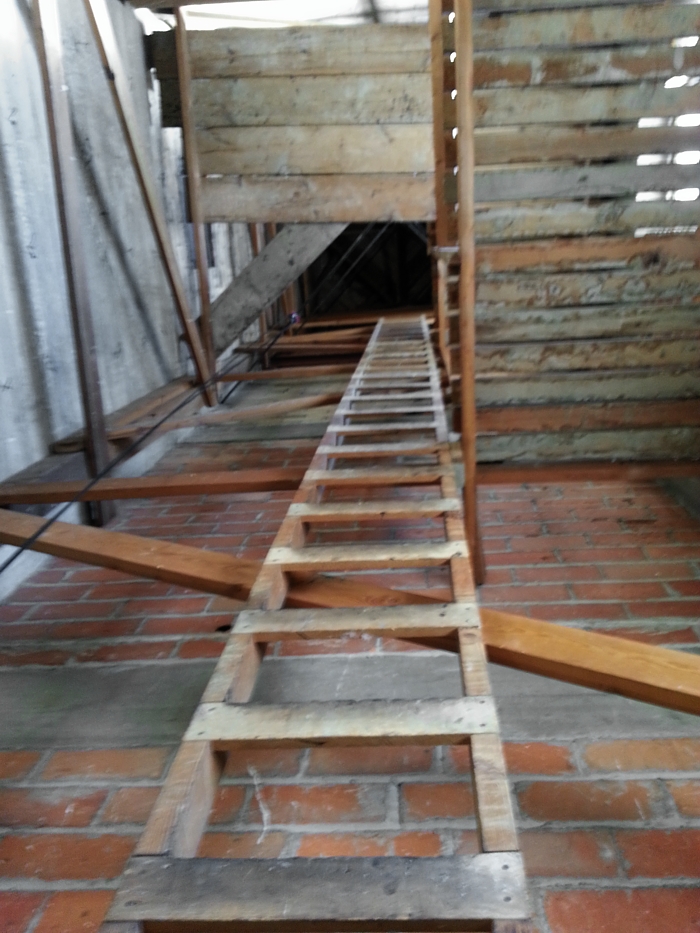
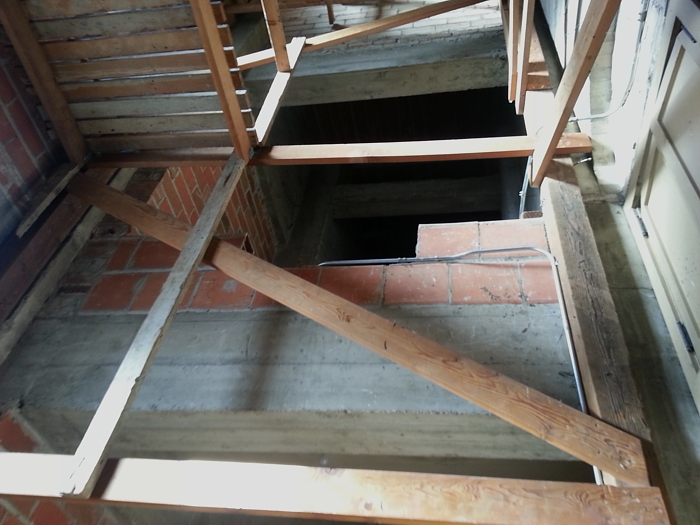
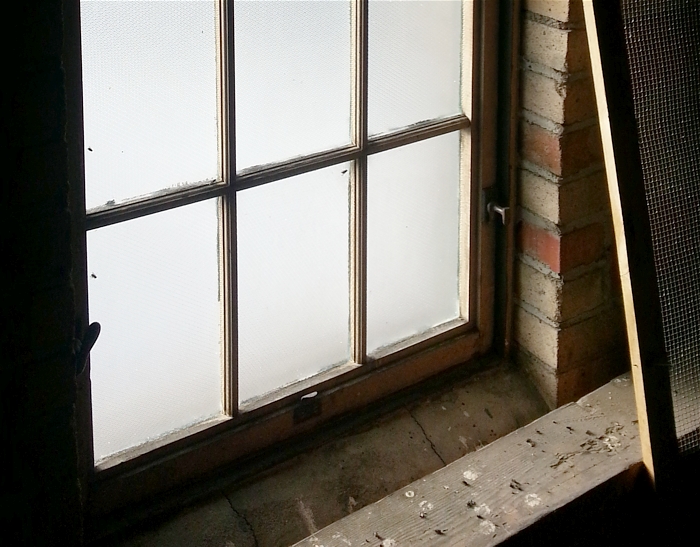
| The removable
windows are accessed by an interior wooden ladder and platform
system. |
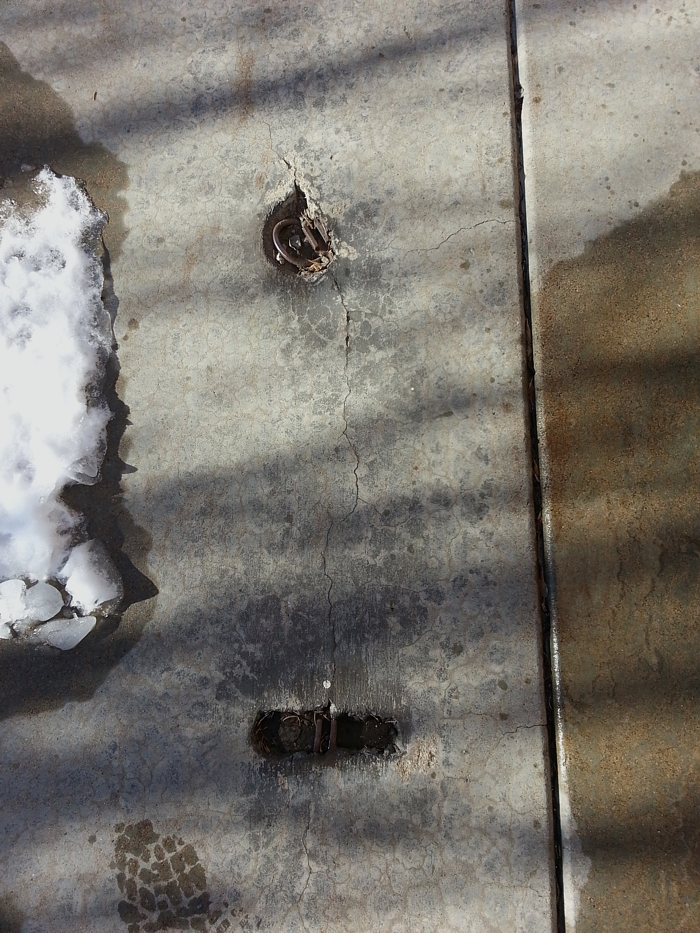
Metal
Rappelling Rope Anchors Embedded in Concrete Below the East Tower
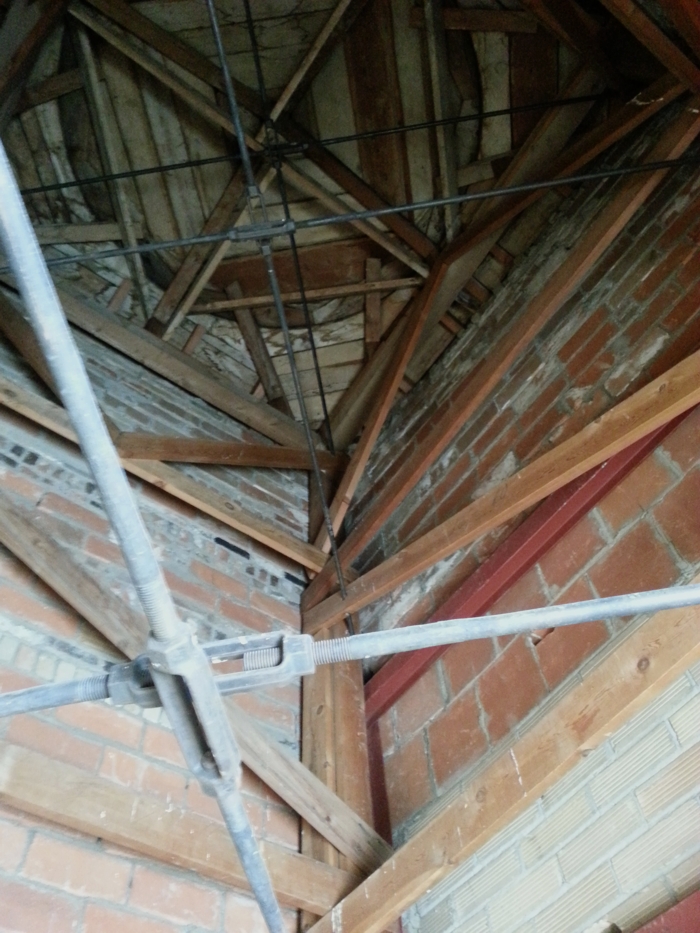
Ladders,
Platforms and Bracing Inside the Tower
Platform
and Window
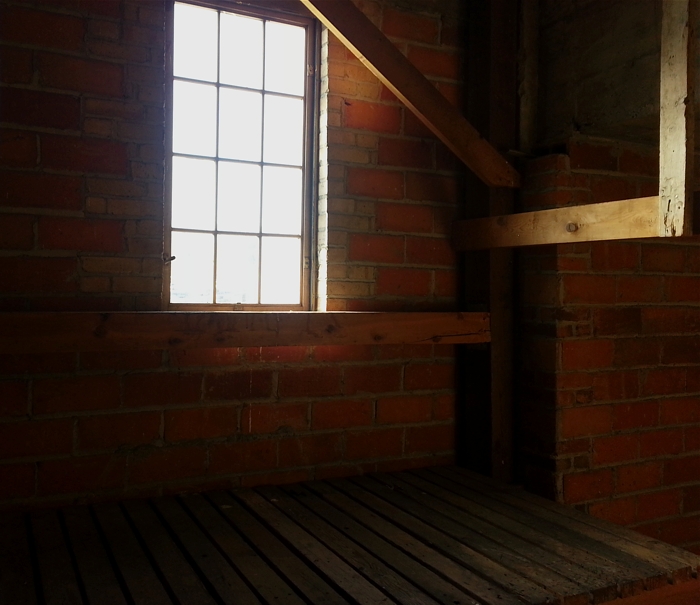
Removable
Window
Turnbuckle Cross Bracing Inside the East Tower
The Base of the Onion Dome
Firemen
Injured
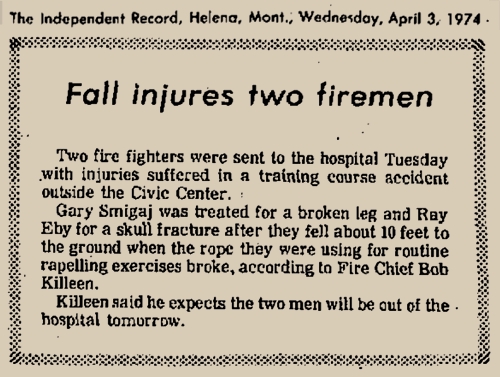
This 1974 incident
apparently ended Civic Center window training.
1947 Model
of the Algeria Shrine

COLLECTION
OF THE ALGERIA SHRINE, THANKS TO SHAWN RATCHFORD
CLICK ON IMAGE TO OPEN A BIG VERSION IN A NEW
WINDOW
This charming model was built by Mrs. William B. (Elva) Kiefner in 1947. Her dates are 1893-1970. The model, along with a desert diorama, was displayed in 1947 in the window of the Haytin Beauty Parlor, 13 W. Sixth Ave.
The model is in the collection of the Algeria Shrine.
|

COURTESY OF LINDA KINDRICK

The
Civic Center Auditorium and Ballroom
Photos by Kathryn
Fehlig ~ September 2009
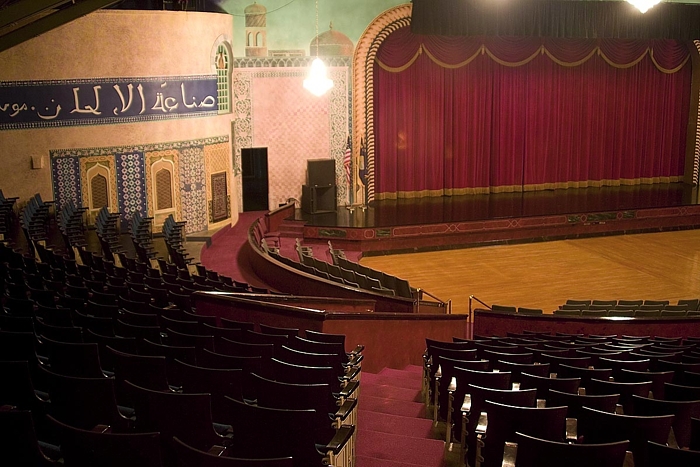
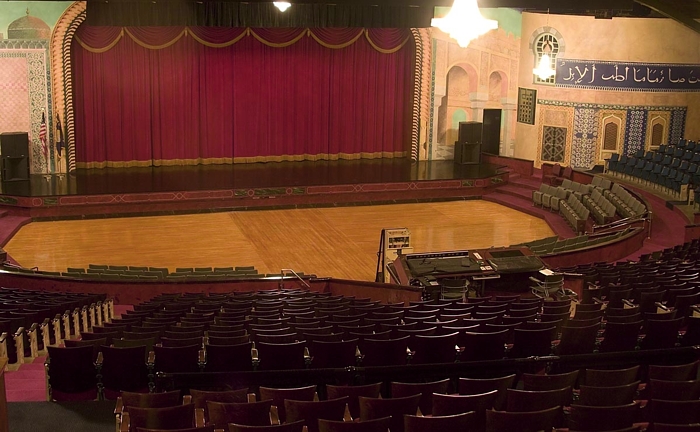
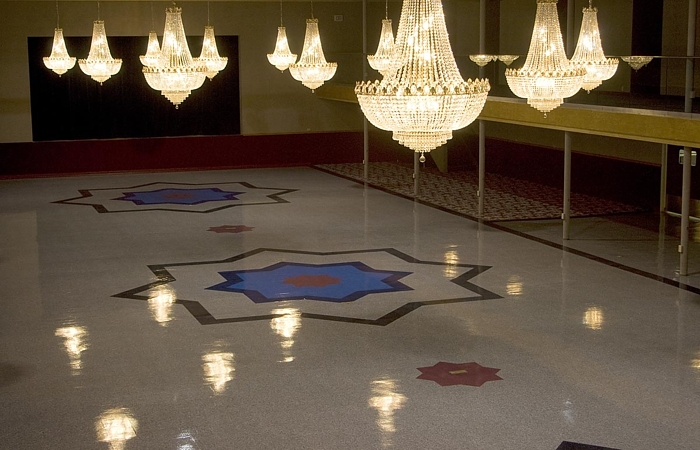
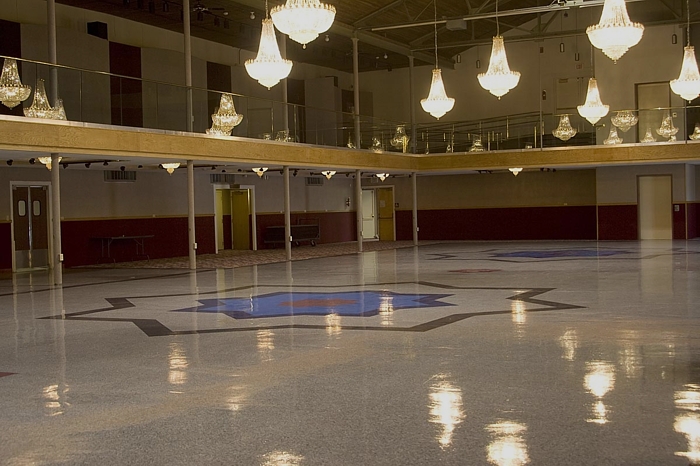
Thanks,
Kathy, for the handsome photos!
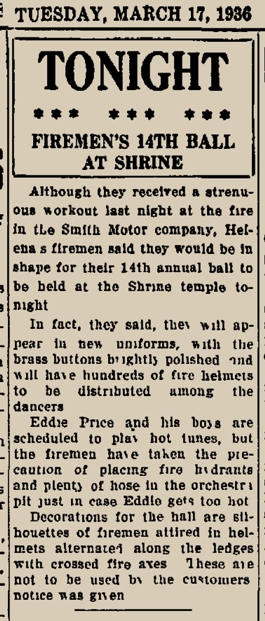
Fireman's
Ball, Civic Center Ballroom, March 17 1936
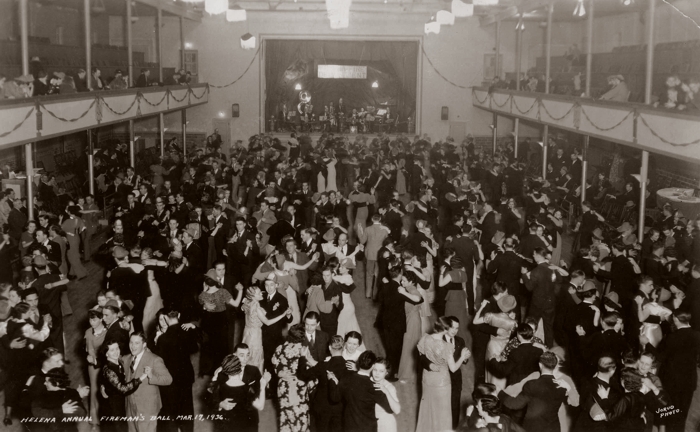
THE
JEZICK FAMILY COLLECTION, COURTESY OF CHUCK JEZICK •
CLICK ON IMAGE FOR A BIG VERSION IN A NEW WINDOW
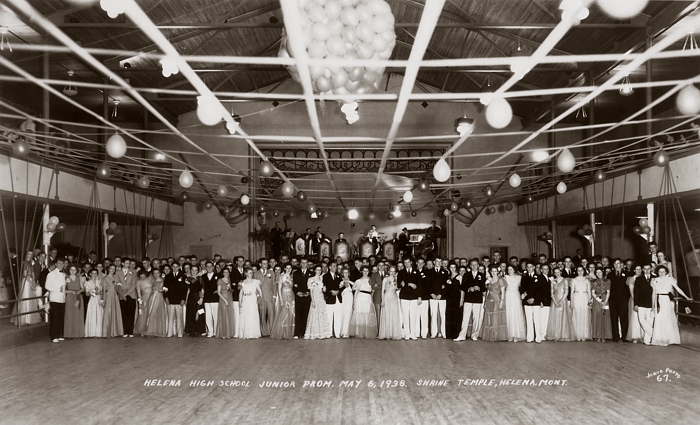
Helena
High Junior Prom, Civic Center Ballroom, 1938
COURTESY
OF WENDI KOTTAS PETERSON •
CLICK ON IMAGE FOR A BIG VERSION IN A NEW WINDOW
Teen
Dance in the Civic Center Ballroom, 1968

COURTESY
OF ROBERT NOEL CLARKSON
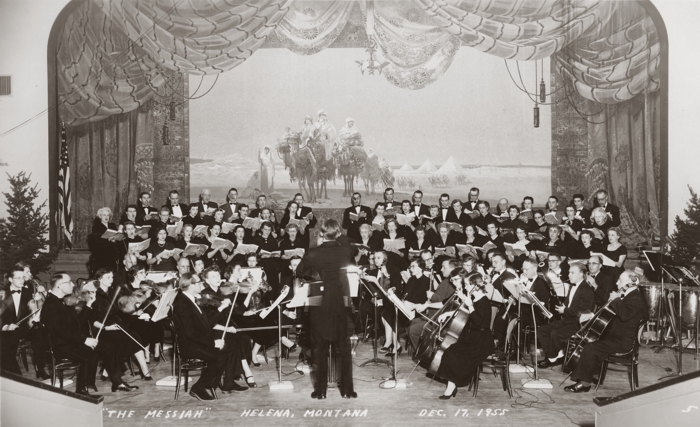
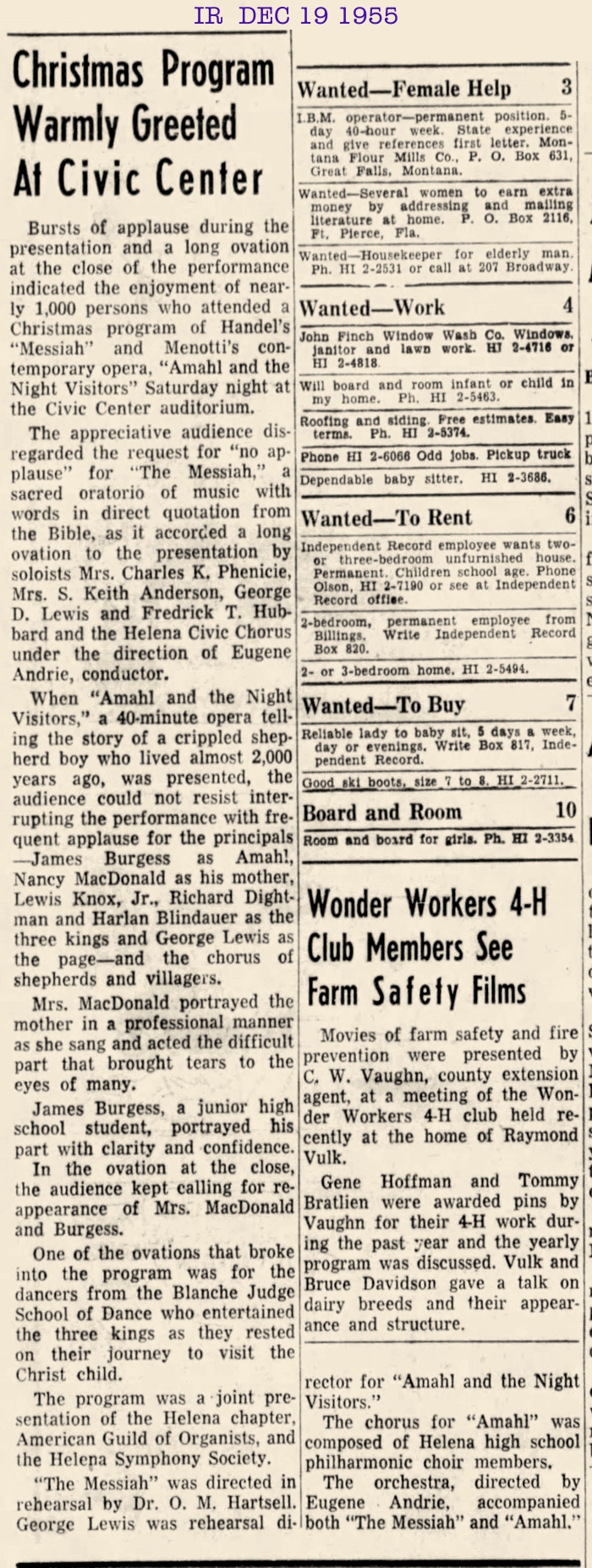
Helena Symphony Performs Handel's Messiah
Civic Center Auditorium, Dec. 17 1955
JORUD PHOTO FROM THE BAIRD COLLECTION
CLICK ON IMAGE TO ENLARGE IN A NEW WINDOW

Hill
Park and Women's Park
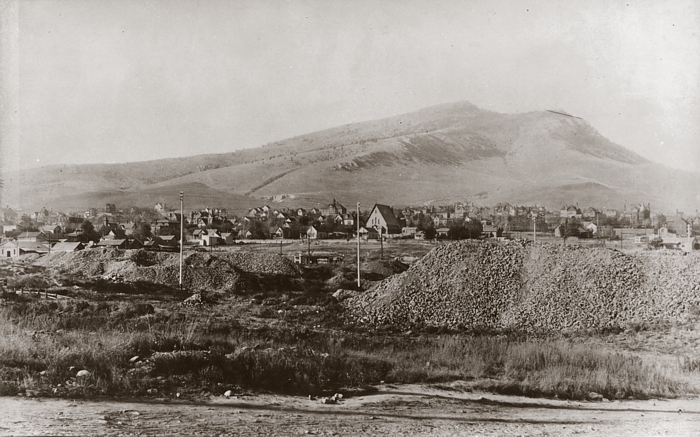
Mine
Tailings on the Future Site of Women's Park, 1897
COURTESY
OF THE DAVID POOR COLLECTION • CLICK ON
IMAGE TO OPEN A BIG VERSION IN A NEW WINDOW
James
J. Hill

IMAGE COLORIZED AND ENHANCED
|
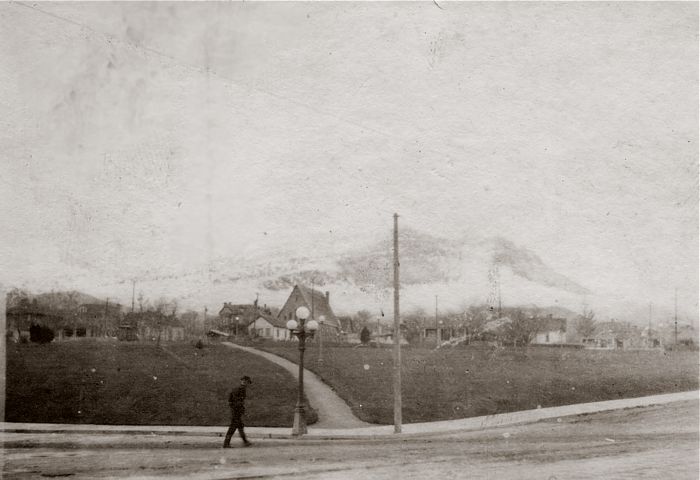
Land for
Hill Park was donated to the City of Helena by James
J. Hill, builder of the Great Northern Railway. In 1914,
the eastern half of the park land was upgraded by the Women's
Park Association...
"The
Women's Park Association was organized in April, 1914. Through
the efforts of the
organization the women's section Hill Park was created, making
one of the unsightly sections of the capital city a beauty spot,
including a grass lawn, broad walks, beds of beautiful flowers,
trees and shrubbery, stone benches, drinking fountains bird
fountains and other artistic garden
furnishings. The women's work continued on for some years and
gave proof of local patriotism and pride in the capital city
of the state. And it is a contribution to Helena which will
be more and more appreciated. The women of the associaion do
not claim all the credit. The men of Helena contributed generousy,
as well as the city officers, ever ready to assist whenever
called upon or help."
Helena
Daily Independent, Sept.1 1929
|
Looking
West Across Hill Park from Neill Ave., ca. 1918
KENNON BAIRD COLLECTION • CLICK ON IMAGE TO OPEN
A BIG VIEW IN A NEW WINDOW
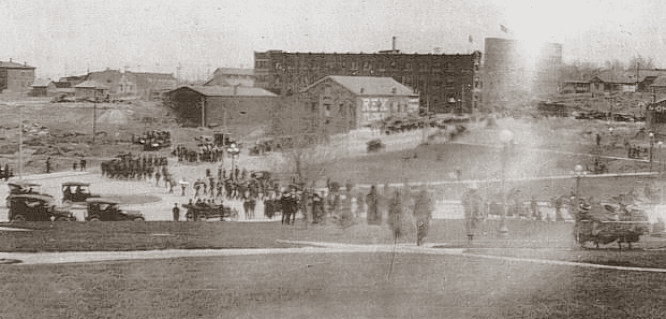
Looking
East Across Hill Park, ca. 1920

THE WES AND CAROL SYNNESS COLLECTION
A parade is making
the turn at Neill Ave. and Fuller. Prominent in the background is
the Steamboat Block.
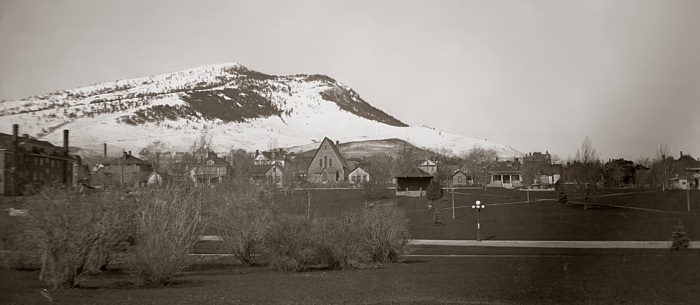
Hill
Park from Women's Park, 1920s
COURTESY
OF SEAN LOGAN • CLICK ON IMAGE TO OPEN
A BIG VIEW IN A NEW WINDOW
The
1916 Confederate Memorial Fountain
Pictured here in 2012
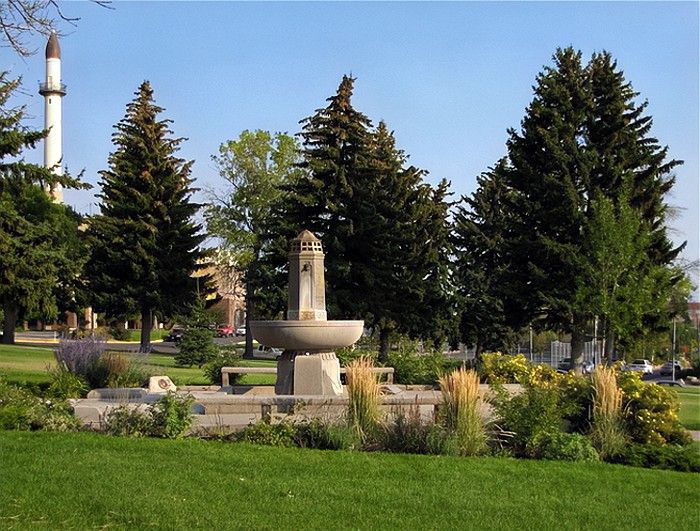
| The Confederate Fountain, donated in 1916 by the Daughters
of The Confederacy. It was removed by the Helena City Council in 2017 amid much controversy. |
Click This Link for The Fountain Page
The
Rustic Bandstand
1922 - circa 1950
Colorized and Enhanced Photo

COURTESY
OF TOM MULVANEY
|
Constructed
in the autumn of 1922, this rustic-style bandstand could accomodate
40 musicians. It was located just southeast of the Confederate
Fountain, part of which can be seen behind the tree on the
left side of the photo.
According
to newspaper articles, the design and placement of the bandstand
left much to be desired. Audiences were downhill from the
bandstand, which would have made sitting down for concerts
quite uncomfortable. The roof projected sound straight down,
so performances were difficult for audiences to hear.
The bandstand
was in use until at least 1945, when it was reported as being
in disrepair. The completion of the bandshell in Memorial
Park in 1949 made the old bandstand totally obsolete. It was
likely demolished around that time.
|
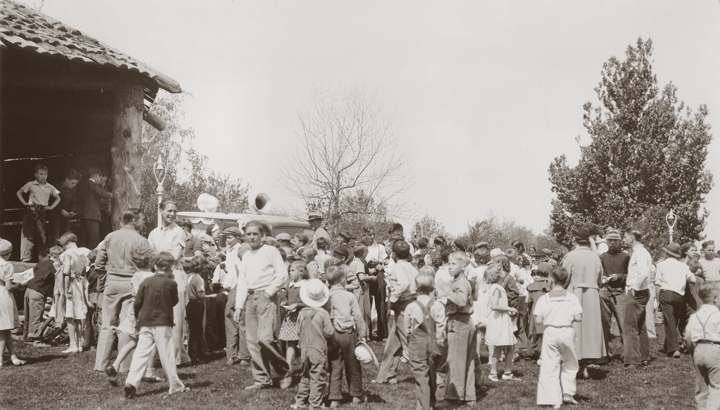
COLLECTION
OF TED KIRKMEYER, COURTESY OF TOM
MULVANEY •
CLICK ON IMAGE FOR A BIG VERSION IN A NEW WINDOW
| The east
side of the bandstand, May 22 1937. The event was a picnic in
Hill Park, sponsored by the Rio Theatre. |
Hill
Park from Women's Park, 1941
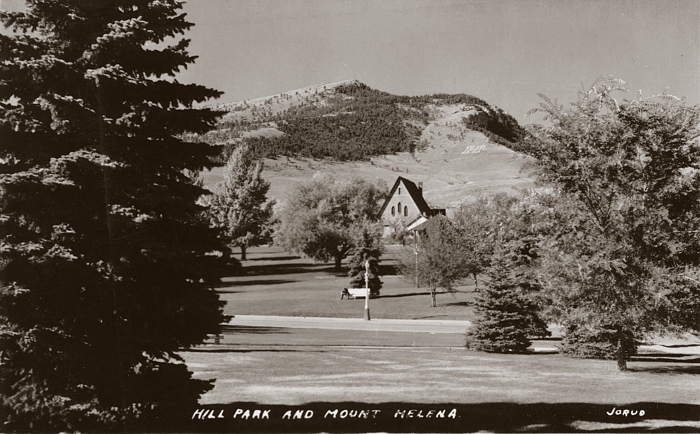
COLLECTION
OF KENNON BAIRD
Looking Northeast from Women's Park, circa 1928
Note Pergola in the Right Background
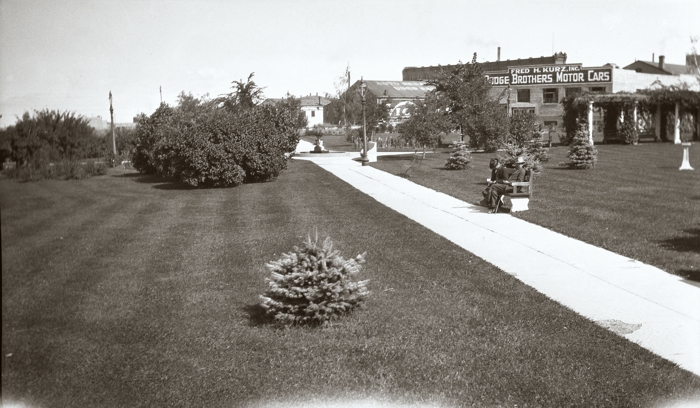
KENNON BAIRD COLLECTION
CLICK ON IMAGE TO OPEN A BIG VERSION IN A NEW WINDOW
Unidentified Woman and Pergola, 1920s

COURTESY OF JANET STELLMON
Unidentified Young Woman and Pergola, ca. 1917
Colorized and Enhanced Photo

COURTESY OF ANDY LOPEZ
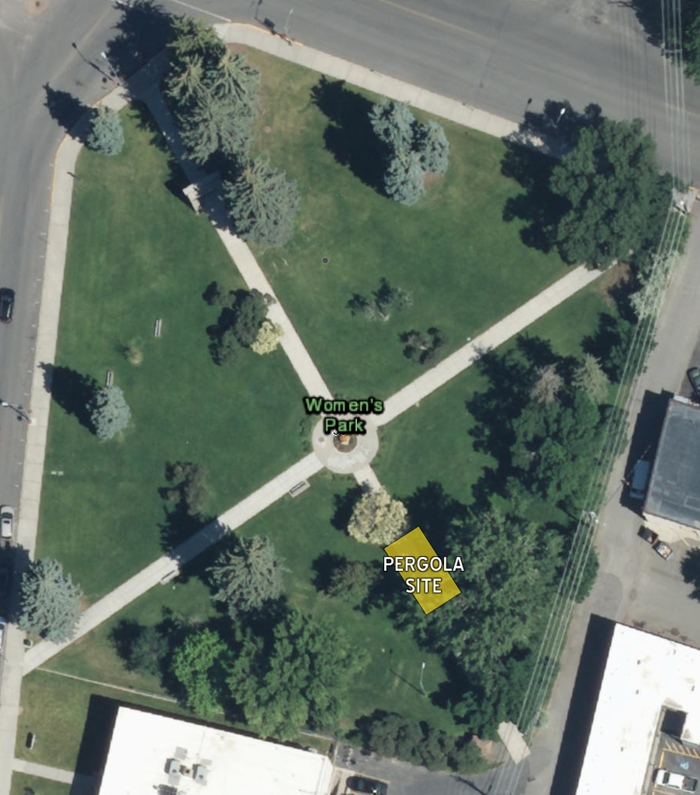
| Installed in 1916, the pergola was the gift of Mrs. Chas. C. Perry. It was designed and constructed by Hartman & Sanders, garden furnishers of Chicago. Local tradesmen did the installation. The date of its removal was not found. |
Pergola Site
Pergola, c.1927
Colorized and Enhanced Photo

KENNON BAIRD COLLECTION
Looking Northeast from Women's Park, circa 1930
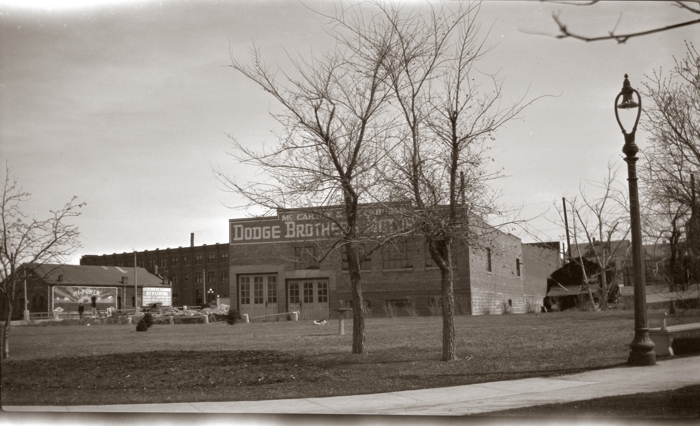
KENNON BAIRD COLLECTION
CLICK ON IMAGE TO OPEN A BIG VERSION IN A NEW WINDOW
Helena
High School Band Members in Women's Park, 1957
Colorized and Enchanced Photo

COURTESY
OF RAY LINDSEY
1965
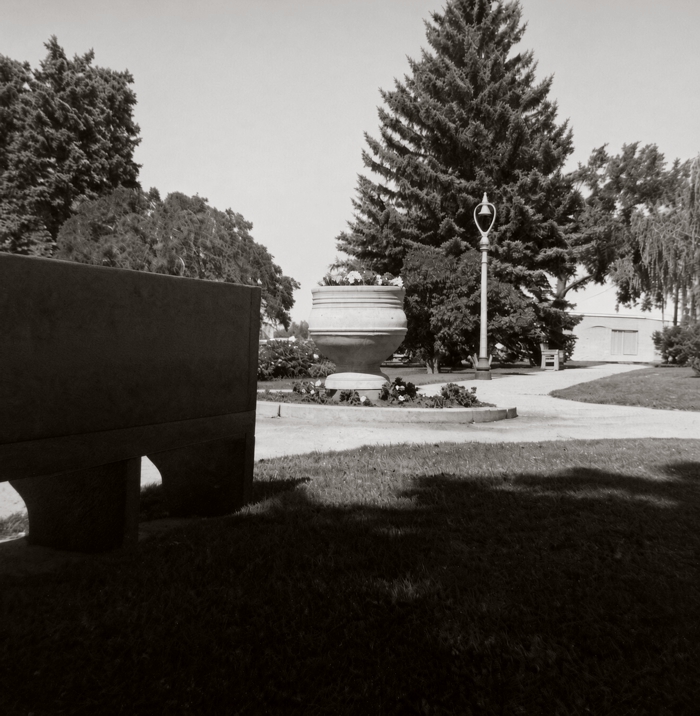
THE MOTCHENBACH COLLECTION
1970s
view of the Civic Center from Women's Park

The
Denver Block Arch in Women's Park
|
Built in
1890-91, the Denver
Block (125 Broadway) was a mixed-use building with businesses
on the street level and flats above. It was damaged by the 1935
earthquakes, but repaired. The Denver Block was spared demolition
during the 1970s Urban Renewal program, but was destroyed by
fire on May 26, 1981.
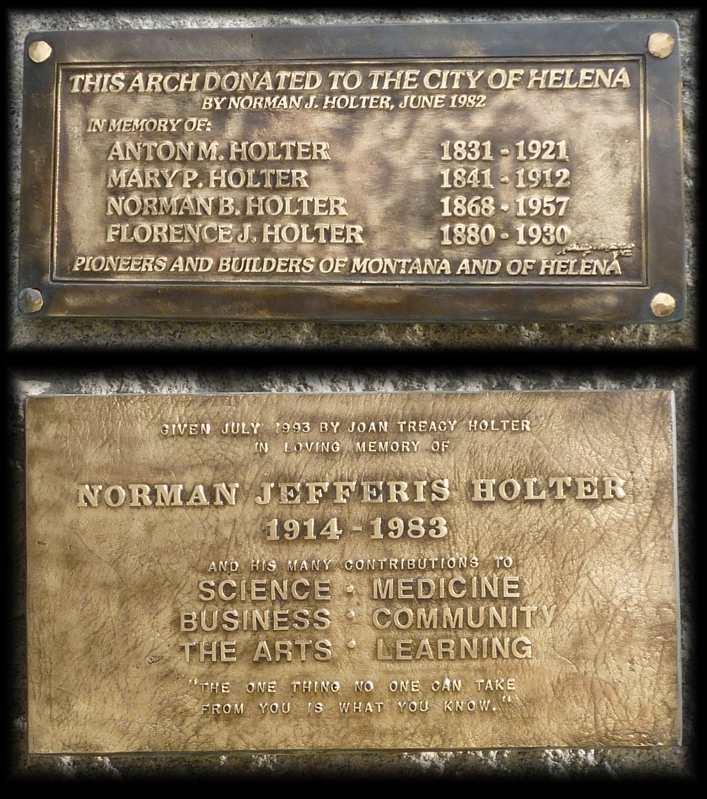
Thanks to
Norman "Jeff" Holter, the granite arch was saved.
It was taken down and reassembled in Women's Park where it stands
today...
|
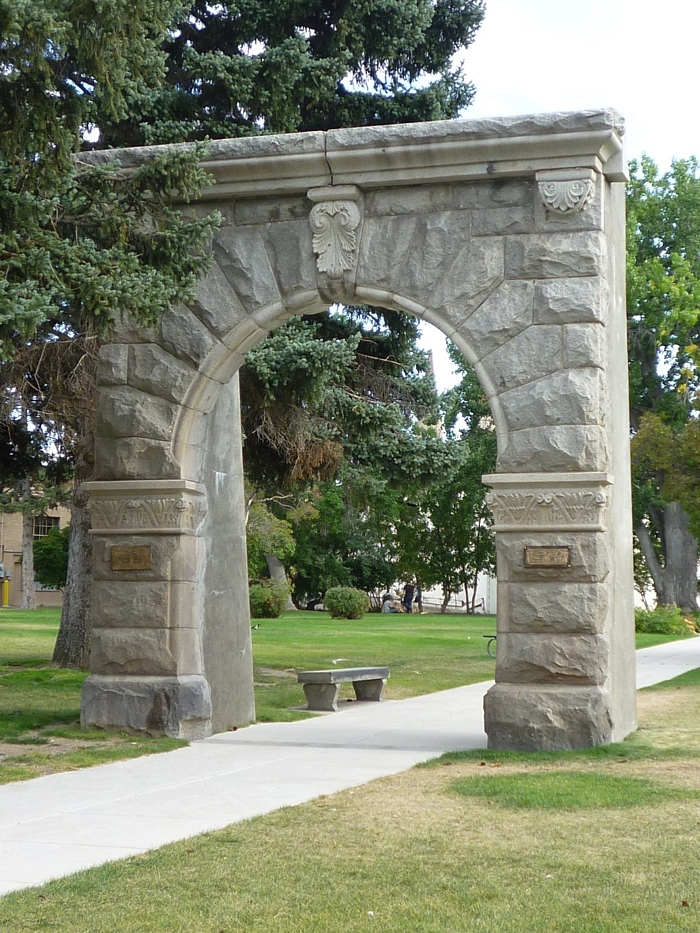
COURTESY
OF SEAN LOGAN • CLICK ON IMAGE FOR A BIG
VERSION IN A NEW WINDOW
Memorial
Plaques on the Arch
COURTESY
OF SEAN LOGAN

|