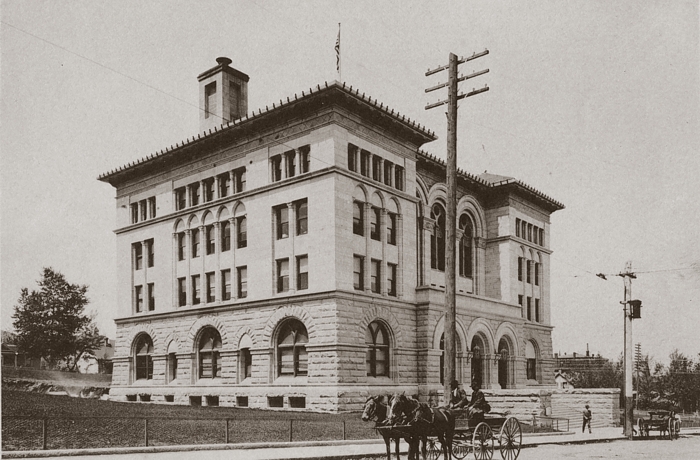
The
North Side of the Federal Building, About 1909
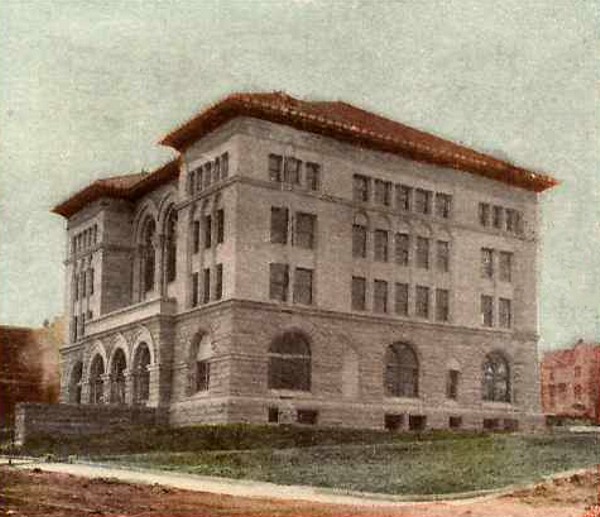
Park Ave. and
Lawrence St. were then dirt roads.
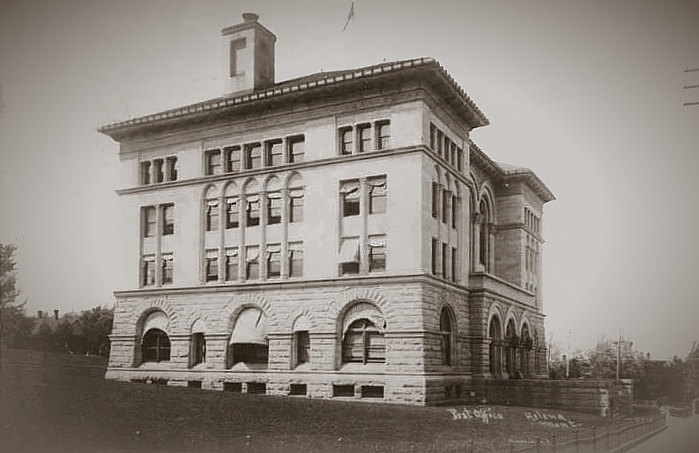
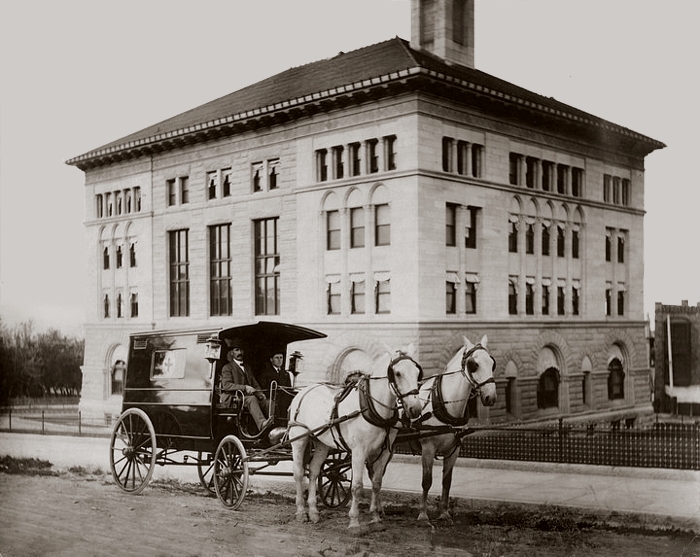
Circa
1910 View of the West Side
Showing an early Helena ambulance on North Benton Avenue
THE
RAY & PHIL JEZICK COLLECTION
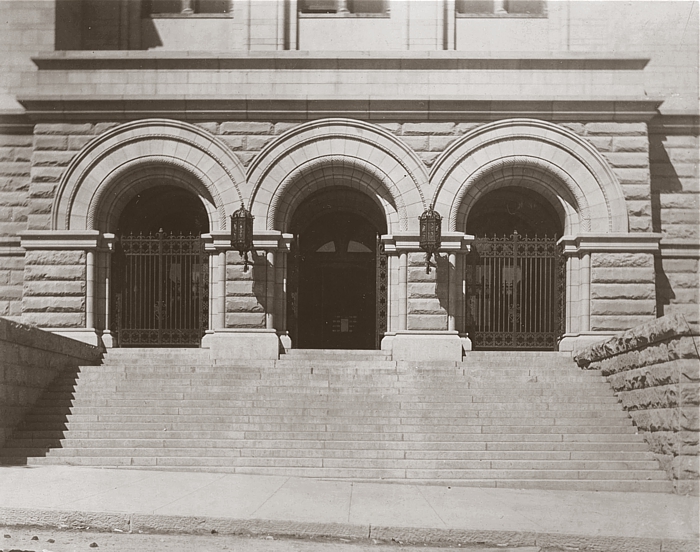
Main Entrance, circa 1904
THE CHARLES J. TIPTON COLLECTION • CLICK ON IMAGE TO OPEN
A BIG VERSION IN A NEW WINDOW
| The wrought-iron gates were removed in 1932, at the beginning of the extensive remodeling of the building, which included the addition on the west side. Permanent handrails were added to the steps in 1935; prior to that, temporary wooden rails, along with wooden "storm steps", were installed during the winter months. |
The
New Federal Building on Souvenir China

A souvenir teacup,
ca. 1910. Ware of this sort was usually made in Germany.
Looking
South, ca. 1920

COLLECTION
OF KENNON BAIRD
Original Iron Gates, 1929
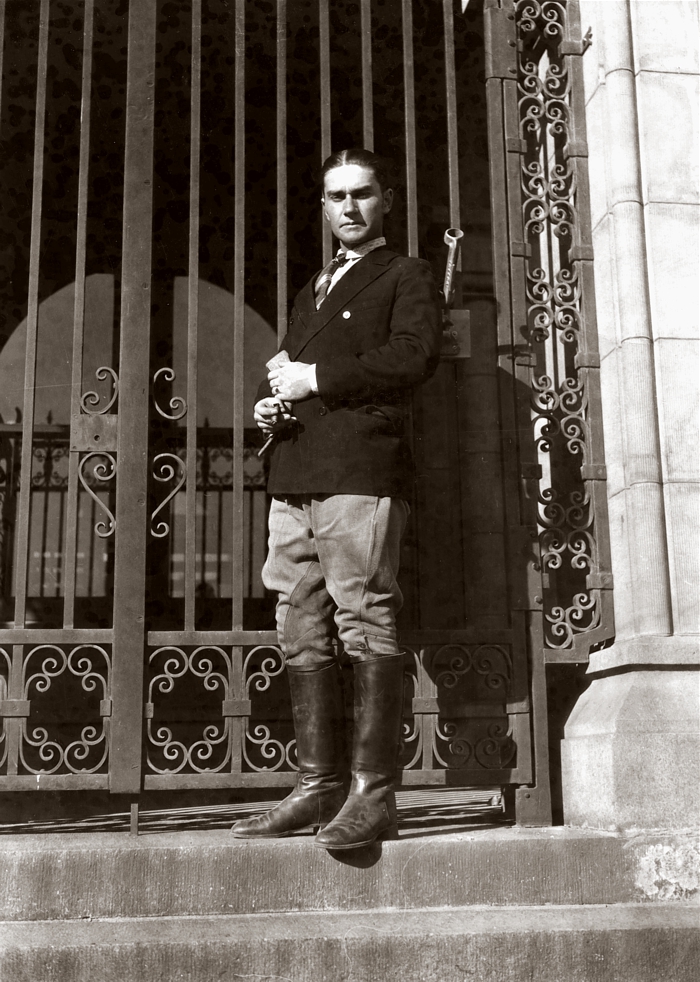
COLLECTION OF KENNON BAIRD • CLICK ON IMAGE FOR A BIG VERSION IN A NEW WINDOW
| Pictured above is one Raymond Lowery standing in front of the Federal Building's original iron gates in 1929. The gates were removed in 1932, as part of the remodeling and enlarging of the building. The whereabouts of the gates are at present unknown, but they may have been scrapped during WWII. |

Mid-1930s
• New Addition

| The large
addition to the rear (west side) of the building was completed
in 1934 at a cost of $320,000 (about $7,600,000 in 2006 dollars).
It is faced with Columbus sandstone quarried in Stillwater County,
the same stone used for the state capitol. In the fall of 1934,
the grounds were plowed up in preparation for the extensive
landscaping of 1935, performed by the State Nursery and Seed
Co. of Helena. The fence was replaced by a hedge of Russian
Olive. |
1933
Suicide Leap
John Alanko

1935
Earthquake Damage Not Extensive
Repairs Underway, Nov. 11, 1935
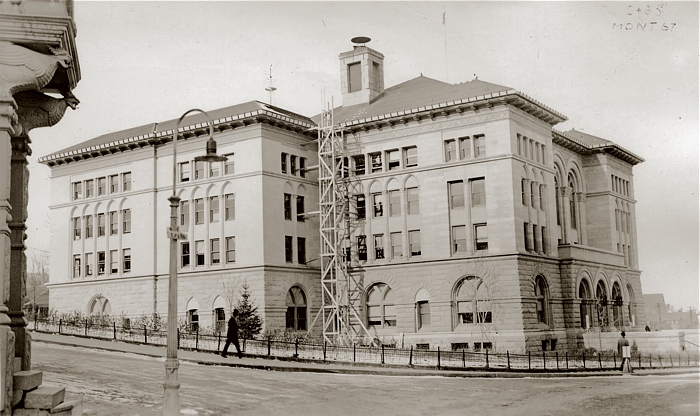
COURTESY
OF THE SEAN LOGAN COLLECTION •
CLICK ON IMAGE TO OPEN A BIG VERSION IN A NEW WINDOW
| Damage to
the Federal Building was limited to cracked plaster and shifting
of the housing around the rooftop stack. The ornate doorway seen
on the left is that of the Homer Block, which was razed during
the 1970s Urban Renewal program. |
Stack
Under Repair, Nov. 14 1935
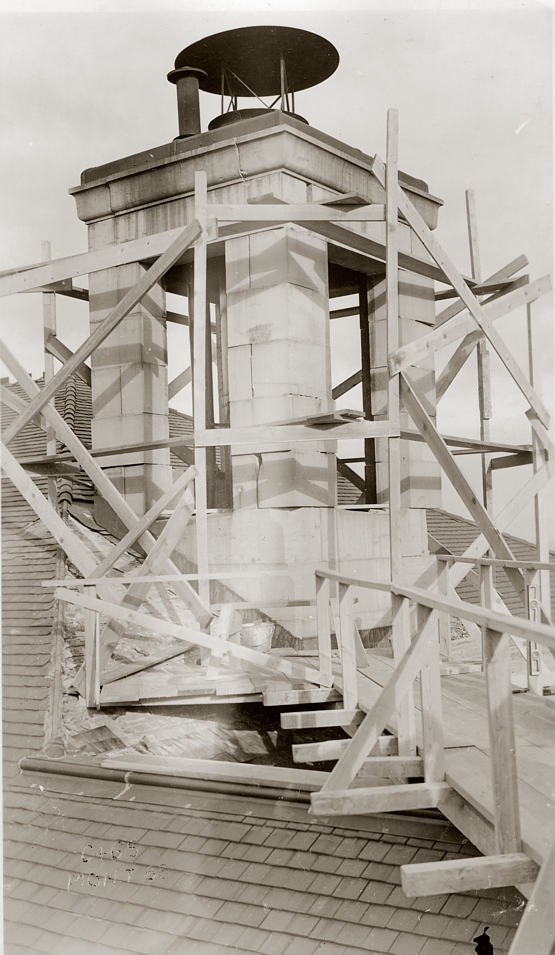
COURTESY
OF THE SEAN LOGAN COLLECTION •
CLICK ON IMAGE TO OPEN A BIG VERSION IN A NEW WINDOW
California
Seismograph Stays in Helena
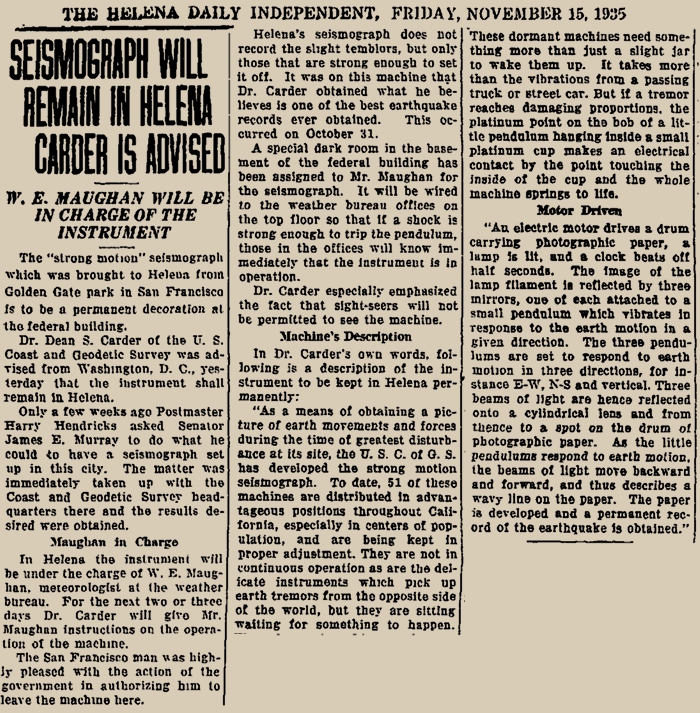
| A
more modern and sensitive instrument was installed in Helena in
September of 1936. The old seismograph from Califorrnia was subsequently
exhibited for two days in the display window of Fligelman's department
store on Main Street, |
Main
Entrance of the Federal Building, 1938
Colorized and Enhanced Photo

COLLECTION
OF TED KIRKMEYER, COURTESY OF TOM
MULVANEY
Morning
on Park Avenue, About 1940

COLLECTION
OF KENNON BAIRD
| In the background
is the ornate Homer Block (1890-1971). This photo was taken in
front of the Bonneville
Apartments. |
Federal
Building from the SE, late 1930s
Photo by Les Jorud

COLLECTION
OF KENNON BAIRD • CLICK ON MAGE FOR A BIG
VIEW IN A NEW WINDOW
| This late
1930s noontime view, taken from the Electric Block, shows the
maturing 1935 landscaping. The Russian Olive hedge was permanently
removed in 1953 as part of a street-widening project. |
A
Dedicated Gardener
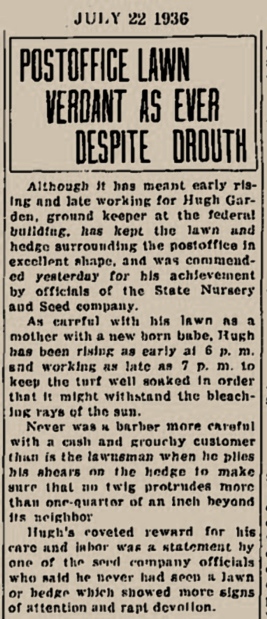
| Hugh
Garden (1897-1965) was a native of Scotland, coming to
Helena in 1917 via Atlanta, Georgia. He began work at
the Federal Building in 1933 as a custodian, retiring
as building superintendent in 1960. He was an avid bowler. |
|
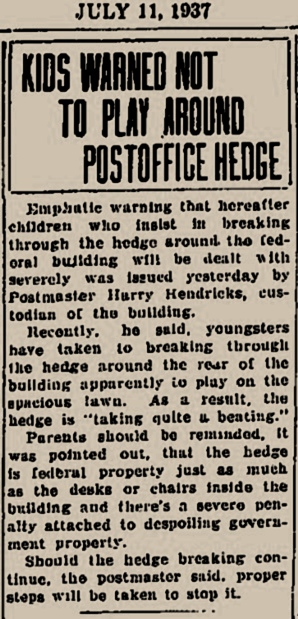
Uncle
Sam to Kids: Get Off My Lawn!
|
|
In
1940, citizens complained in the Helena Independent
that the hedge around the Federal Building had grown
so high that only the tallest people could see the grounds;
the hedge also created a traffic hazard, blocking drivers'
vision at the streetcorners. There were also complaints
that there was no sidewalk across the south lawn, requiring
the public to walk an extra distance to the front entrance.
Suggestions were made to create a kind of park on the
south lawn, making the grounds a more hospitable place
than the "island entirely surrounded by stop signs"
it had become.
Today,
the City-Country Building grounds are basically one
big parking lot, with hardly any green remaining.
|
|
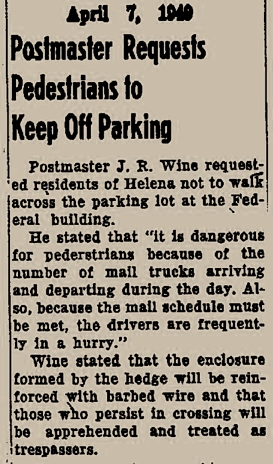
A hard
line from Postmaster Joseph Raymond Wine
|
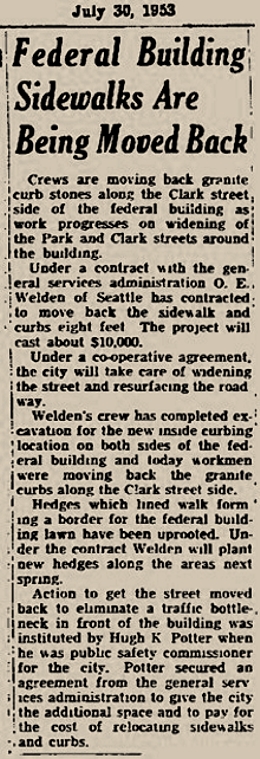
The hedge
was never replaced.
|
Federal
Building, Late 1940s
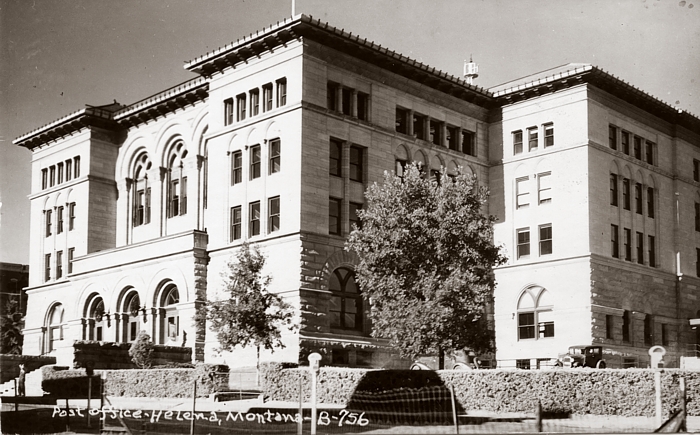
COLLECTION
OF KENNON BAIRD • CLICK ON MAGE FOR A BIG
VIEW IN A NEW WINDOW
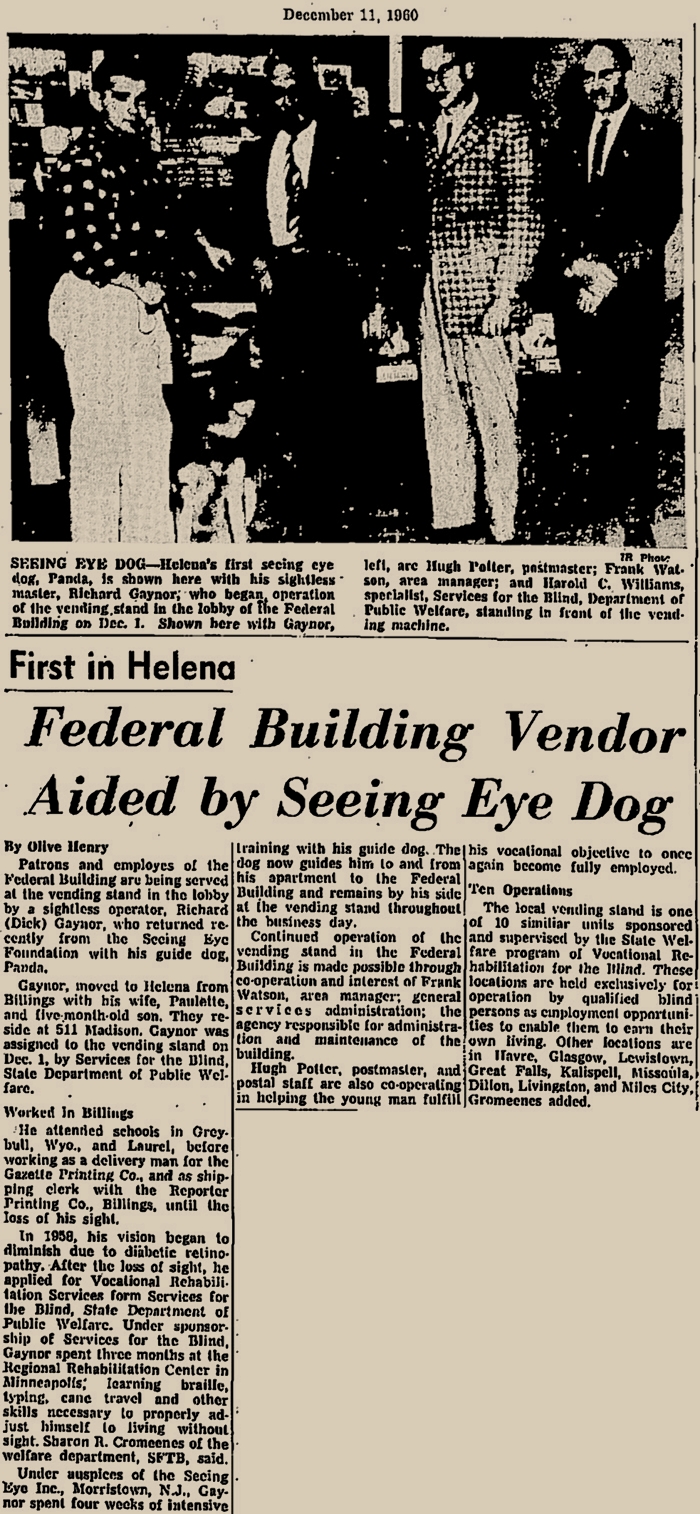
Blind
Man Operated Vending Stand
Aided by "Panda", Helena's First Seeing-Eye
Dog
| Many baby-boomers
will recall the newsstand in the lobby of the Federal Building,
operated by Richard Gaynor. It was one of ten such stands in Montana. |
|
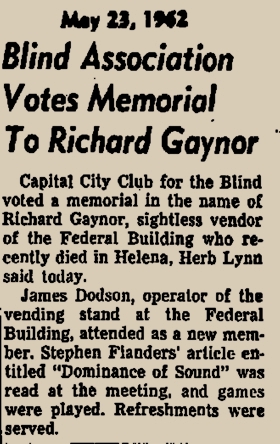
Richard
Gaynor died in Helena on May 7, 1962, after a "lengthy
illness" (presumably diabetes). He was only 26 years old.
Gaynor is buried in the Mountain View Cemetery in Billings.
James Dodson
subsequently took over operation of the newsstand.
|

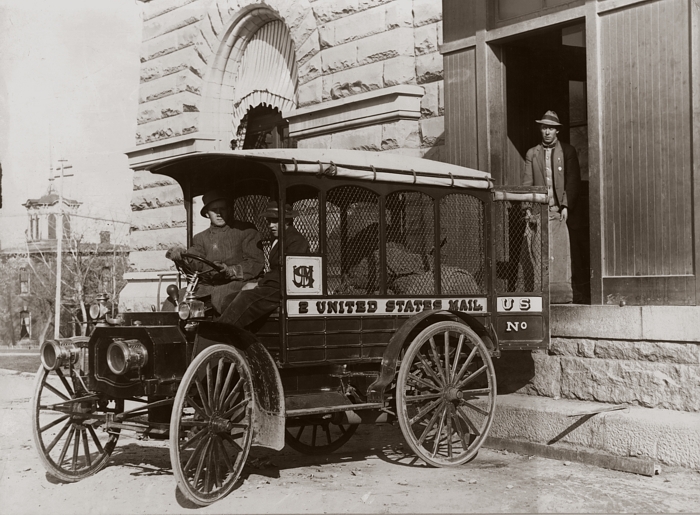
U. S. Post Office in the Federal Building •
1904-1976
United
States Mail Delivery Trucks in Helena, circa 1914

COURTESY
OF THE DAVID POOR COLLECTION • CLICK ON
IMAGE FOR A BIG VERSION IN A NEW WINDOW
COURTESY
OF THE DAVID POOR COLLECTION • CLICK ON
IMAGE FOR A BIG VERSION IN A NEW WINDOW
| This loading
dock was located near the northwest corner of the building before
the construction of the 1934 addition. The house in the background
stood on the northwest corner of Park Ave. and Lawrence St., where
the Federal Reserve Bank (now the Reserve Financial Center) was
built in 1938. |
Helena
Postal Worker, Early 1900s

COURTESY
OF THE KENNON BAIRD COLLECTION
Two
Views of the Federal Building Lobby and Post Office, 1970s
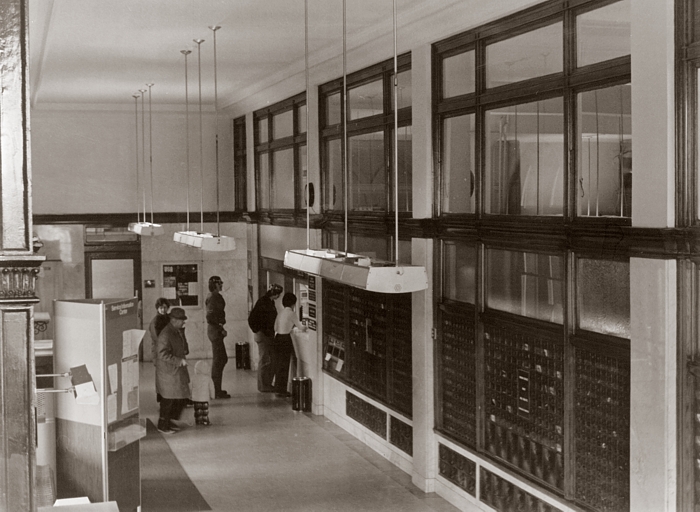
COURTESY
CITY OF HELENA / LEWIS & CLARK COUNTY •
CLICK ON IMAGE TO OPEN A BIG VERSION IN A NEW WINDOW
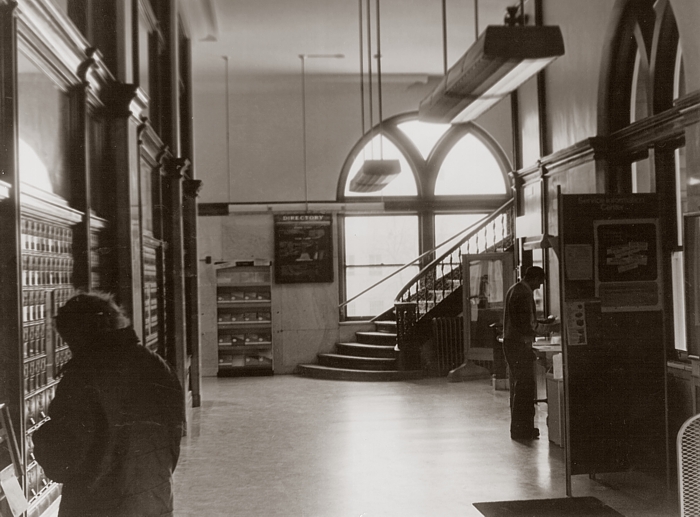
COURTESY
CITY OF HELENA / LEWIS & CLARK COUNTY •
CLICK ON IMAGE TO OPEN A BIG VERSION IN A NEW WINDOW
Small
Mailbox
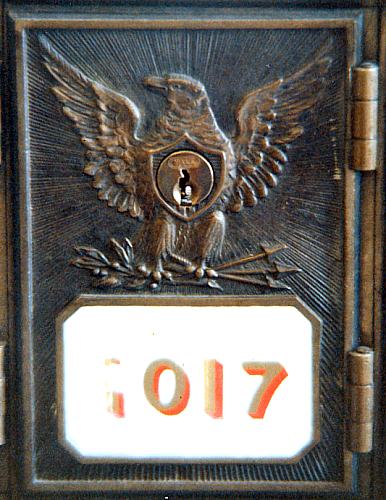
PHOTO
BY KENNON BAIRD
| Photo taken
ca. 1985. There were banks of such boxes, in several sizes, lining
the lobby walls. This is an example of the smallest size. |
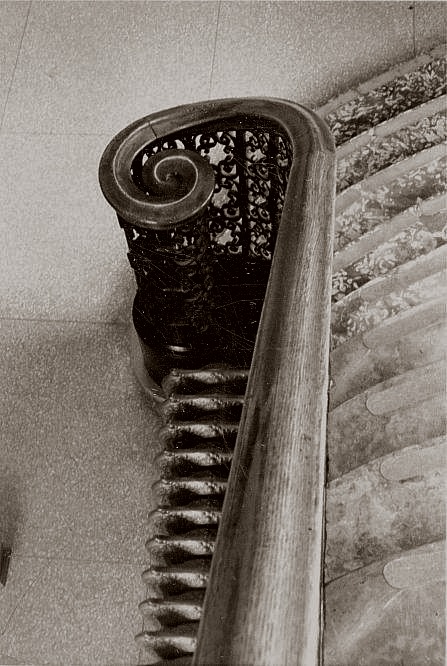
Stairs
In the Federal Building Lobby, 1970s
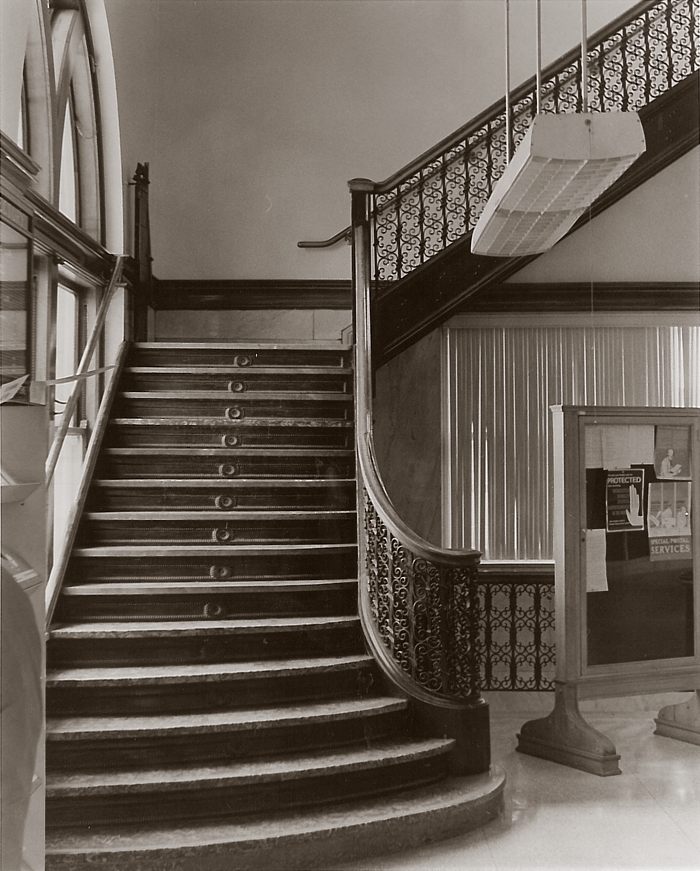
COURTESY
CITY OF HELENA / LEWIS & CLARK COUNTY •
CLICK ON IMAGE TO OPEN A BIG VERSION IN A NEW WINDOW
PHOTO
BY KENNON BAIRD
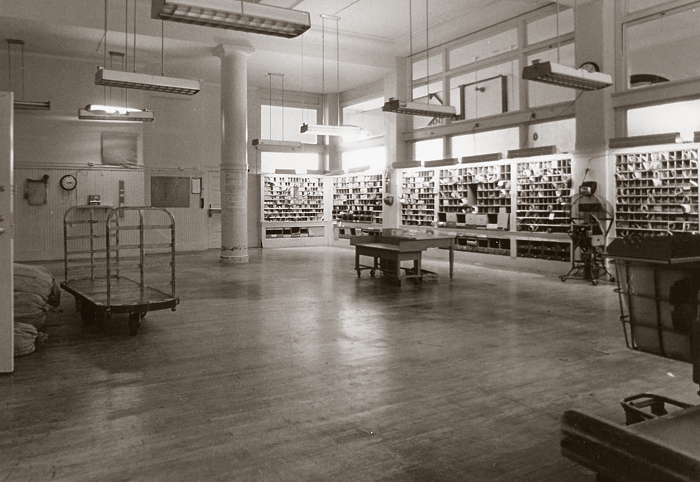
Two Views of the Post Office Sorting Area, 1970s
COURTESY
CITY OF HELENA / LEWIS & CLARK COUNTY •
CLICK ON IMAGE TO OPEN A BIG VERSION IN A NEW WINDOW
|
Retired
Helena postal employee Stephen Andre explains the unusual-looking
machine seen against the pillar on the right:
"That machine is for strapping a bundle of mail together,
usually like a bundle of magazines or newspapers.
On the bottom part of the machine is a big spool of strapping
twine. If you had a bundle of magazines that you wanted to be
held together, you lay them on the table above the spool of
strapping twine, and a mechanical arm with the twine swings
around the magazines and ties them into a tight little bundle.
Then you'd rotate the bundle 90 degrees and wrap it one more
time, so that it holds together securely.
The circular hood over the machine is a safety cage, in case
anyone might be stupid enough to have their head over the bundle
when the arm swings around."
Thanks,
Steve!
|

COURTESY
CITY OF HELENA / LEWIS & CLARK COUNTY •
CLICK ON IMAGE TO OPEN A BIG VERSION IN A NEW WINDOW
View showing part
of the sorting area, partitioned-off work area and the main service
window.
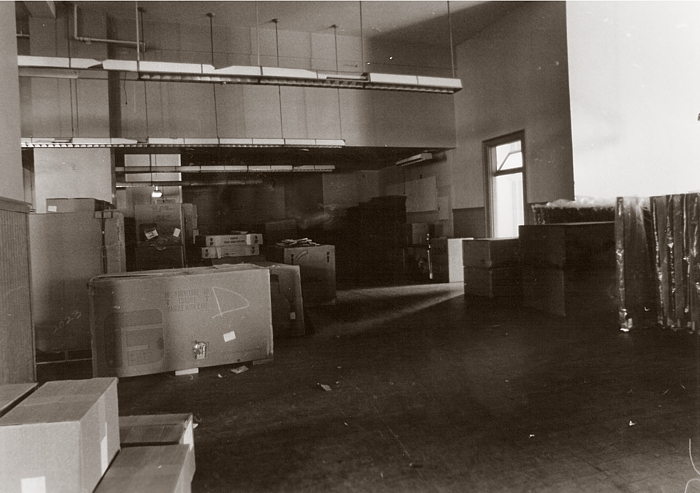
Two
Views of Moving Furniture and Equipment, 1976-77
Transitioning from Federal Building to City-County
Building

COURTESY
CITY OF HELENA / LEWIS & CLARK COUNTY •
CLICK ON IMAGE TO OPEN A BIG VERSION IN A NEW WINDOW
COURTESY
CITY OF HELENA / LEWIS & CLARK COUNTY •
CLICK ON IMAGE TO OPEN A BIG VERSION IN A NEW WINDOW
Miscellaneous
Views
Federal
(City-County) Building Foyer, 2009

PHOTO
BY KENNON BAIRD
Marble
Shelf, 2013

PHOTO
BY KENNON BAIRD
There were originally
several of these shelves in the Post Office lobby.