MacDONALD PASS
ONCE A FRONTIER TOLL ROAD
Modern highway completed in 1932 - widening completed in 1979

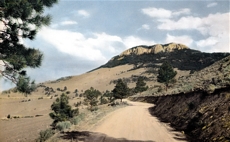
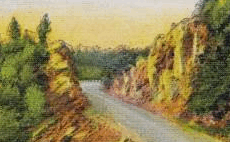
1930's postcard view of the eastern slope of MacDonald Pass

MacDonald (often "McDonald") Pass was originally a toll road over the Rocky Mountains. It was not, however, the main Helena-area route over the Continental Divide until 1932. Prior to that, the winding Priest Pass road (also a former toll road), which crosses the divide four miles north of MacDonald Pass, was the primary route; the Mullan Pass, seven miles north, was another way.


THE OLD MacDONALD PASS TOLLHOUSE


FROM "VALLEYS OF THE PRICKLY PEAR" ©1988 LITTLE RED SCHOOLHOUSE, INC. -- NOW OUT OF PRINT

The Macdonald Pass tollhouse still exists, as part of a private home. The man for whom the pass is named, Ontario native Alexander MacDonald, was an employee of E. M. Dunphy, the man who built the road in 1870. MacDonald operated the tollhouse for Dunphy, and bought him out in 1876.

The first road was comprised simply of logs laid across a roadbed. Several men were employed full-time to cut logs and repair the road. MacDonald sold the road to David H. Gilmore in 1883.


For a detailed history of the romantic old routes of MacDonald, Priest and Mullan passes, click on the image below to download a pdf file of Jon Axline's "The Frenchwoman and MacDonald Pass", in the June 2005 Newsline - the Newsletter of the Montana Department of Transportation. Mr. Axline's history begins on page six...


CLICK TO DOWNLOAD PDF FILE

In 1920, the Montana State Highway Commission began the work of locating a new road over the Rockies. They looked at three routes: MacDonald Pass, Priest Pass and Mullan Pass.

A public controversy arose in 1925, when Lewis and Clark County commissioners proposed simply upgrading the Priest Pass road. It was pointed out by concerned citizens that not only was the east slope road on Priest Pass winding and dangerous, but the road on the west slope, in Powell County, was not maintained; much of it lying in low, wet ground. It was also noted that MacDonald Pass offered better scenic views, and that the area's decomposed granite would provide a superior roadbed. The cost of building a highway over MacDonald Pass, however, would be higher as there was no existing maintained roadbed over the grade.

By 1926, Lewis & Clark County Commissioners had turned their attention to upgrading Mullan Pass, an old road some seven miles north of MacDonald Pass. This proposal was likewise met with objections, the main one being that it would effectively reroute a great deal of traffic past Helena. As late as 1928, an Independent Record editorial objected to money being spent on the MacDonald Pass route, saying that improving other area roads was more important than building "...another pass over the mountains to the west."

In 1929, a federal Bureau of Public Roads survey was made of the MacDonald Pass route. On May 15 1930, it was announced in Helena by State Highway Commission and federal roads officials that 14 miles of highway would be constructed over MacDonald Pass. Most of the money would come from Forest Service funds. Contracts were let, and construction began in 1931...


The 1930s Road


A 1930s-40s View of the Eastern Slope


MacDonald Pass in the 1950s, looking east


A 1950s springtime view


TEN MILE CREEK

Ten Mile, Three Mile and Seven Mile Creeks were so named around 1865 for their distance from Silver City (then the seat of Edgerton County, later Lewis & Clark County) toward Last Chance Gulch. Silver City, located about 13 miles NW of Helena, is little more than a crossroads today.

Ten Mile Creek begins in this high meadow, some 15 miles SW of Helena, above the old mining town of Rimini...


Rimini, with Red Mountain in the background, about 1950


COLLECTION OF BOB & SUSIE LINDEBERG


Postcard view of Red Mountain and Ten Mile Creek, about 1900


What is now US Highway 12 was a dirt road in the 1890s.


Ten Mile Creek, west of Helena, ca. 1900


Bridge near Helena, ca. 1890. Likely over Ten Mile Creek near Broadwater


An outing near Broadwater, west of Helena, ca. 1890


1894 Williams Street Bridge
Slated for Removal in 2009


PHOTO BY KENNON BAIRD

1894 Williams St. Bridge spanning Ten Mile Creek, 1980s.
Built by the King Bridge Co., Cleveland, Ohio

The following is excerpted from a comprehensive report written by Jon Axline for the Williams Street Bridge nomination to the National Register of Historic Places:

"The Williams Street Bridge is an excellent example of a single-span pin-connected Pratt pony truss bridge. The bridge was built in 1894-1895 shortly after the opening of the nearby Broadwater Hotel and Natatorium resort and about the time the U.S. Army began construction of Fort Harrison about one mile north of the bridge. The bridge is located within a residential subdivision that was established in 1889 in conjunction with the resort.

"The Williams Street Bridge provided access to a portion of the Broadwater property, the residential subdivision, and the fort. It also facilitated access from the Helena Street Railway trolley to the Kessler Brewery and the Central Park. It was also constructed when Lewis and Clark County was improving its infrastructure system during the depths of the Panic of 1893.

"The bridge is also significant as the oldest pin-connected Pratt pony truss bridge remaining in Montana."

After it is dismantled in the summer of 2009, the bridge will be stored on Lewis & Clark County property in the Helena Valley.


Location of the Williams Street Bridge


Read historian Jon Axline's excellent 2005 Historic American Engineering Record paper about the Williams Street Bridge and the surrounding area.


MSWORD FILE COURTESY OF JON AXLINE


The site before the bridge was built, ca. 1892

A small bridge of some sort spanning Ten Mile Creek can be seen.


The Williams St. Bridge, probably late 1960s


PHOTO BY KENNON BAIRD

If you look closely, you can see a boy hanging by his hands from the eyebars beneath the bridge. Your editor, who grew up near this bridge, recalls engaging in this sport of crossing the creek hand-over-hand via the eyebars -- sometimes with wet results.


Ten Mile Creek and the Williams St. Bridge, 1970


PHOTO BY KENNON BAIRD


Under the Williams St. Bridge, 1980s


PHOTO BY KENNON BAIRD


Ten Mile Creek in flood at the Williams St. Bridge, 1982. Person unidentified


COURTESY OF SCOTT NELSON - THE BRIDGEWORKS CONSERVANCY


2004 Views of the Willams Street Bridge
Photos by Kristi Hager • Library of Congress

East Side from Ten Mile Creek


Northern Approach


East Walkway


West Side


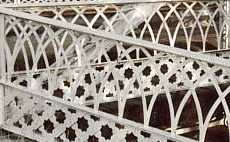
Decorative Motif


Stonework, South End


1946 Repairs


Looking north on Williams St., just north of the bridge, 1980s


PHOTO BY KENNON BAIRD


STATE NURSERY & SEED CO.


COURTESY OF SCOTT NELSON - THE BRIDGEWORKS CONSERVANCY

State Nursery & Seed Co., 1901. Charles A. Broadwater, Helena railroad magnate and builder of the Broadwater Hotel and Natatorium, sold to one Mr. T. E. Mills of London, England the property for the nursery in the late 1890s. Mills did the landscaping for the nearby Broadwater resort, and by 1914 had built six acres of greenhouses in the little valley on the banks of Ten Mile Creek.


Detail of previous photo.


State Nursery & Seed Co. employees, 1897


COURTESY OF SCOTT NELSON - THE BRIDGEWORKS CONSERVANCY CLICK ON IMAGE TO ENLARGE

Nursery owner T. E. Mills is on the right, smoking a pipe. Note the dogs, cat and bird.


The Mysterious Saddlehorn Rocks


COURTESY OF SCOTT NELSON - THE BRIDGEWORKS CONSERVANCY

State Nursery & Seed Co. employees, date unknown. They are gathered at the "Saddlehorn" rocks on the hillside north of the nursery. Some say the spot has mysterious qualities; at least one person is buried there.


1910 Postcard view of the State Nursery


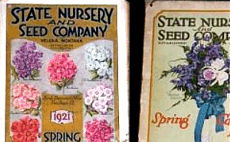
State Nursery catalogs from 1921, 1922 & 1931


State Nursery ad, 1920s


State Nursery & Seed Co., aerial photo, 1953


COURTESY OF SCOTT NELSON - THE BRIDGEWORKS CONSERVANCY


KESSLER BREWING COMPANY

NICKOLAS KESSLER
1832-1901


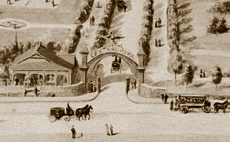
The Kessler Brewery, as engraved for an 1890 perspective map of Helena


LIBRARY OF CONGRESS

Founded in 1868 by Luxembourg-born Nickolas Kessler, the Kessler Brewing Company was located just west of todays' Spring Meadow Lake.

Kessler also operated a brickyard near the brewery, and in this way helped to build the city of Helena. By all accounts, Kessler was an exceptionally friendly and honest man, and his death was widely mourned. Kessler School, one-third mile SE of the old brewery, is named for him.

Helena's world-reknowned Archie Bray Foundation for the Ceramic Arts had its beginning in Kessler's brickyard. Click here for the story, courtesy of the State of Montana's visitmt.com website.


Kessler Brewery, ca 1890


Kessler Beer delivery wagon


Two handsome Kessler Brewing Co. advertising bar trays, ca. 1900


Kessler Loreli Beer advertising ashtray, date unknown


Kessler Bavarian beer label, date unknown


Kessler Muenchener Kindl Beer label, date unknown


Kessler Brewing Co. workers, ca. 1880


1935 EARTHQUAKE DEATHS AT THE BREWERY
STACK UNDER REPAIR COLLAPSES DURING SECOND BIG QUAKE

Repairs underway at the Kessler Brewery following the 1935 earthquakes. Vincent Kennedy and Ed O'Brien were killed by an earthquake on October 31, 1935 as they worked to repair the damaged brick stack seen here (this photo taken after the accident). Kennedy and O'Brien had come to Helena with a crew of brick masons from Salt Lake City, and were rooming at 118 North Warren.

The chimney had been badly cracked by a previous quake, and the two men were removing all the bricks from the top down to the start of the crack. They had just reached the place where the crack began when another severe earthquake occured. Much of the remaining stack collapsed, and the two men hit the ground in a cascade of falling brick. O'Brien died at the scene, Kennedy died a short time later at St. Peter's Hospital.


A 1940s aerial view of the Kessler Brewery


COURTESY OF KATHRYN FEHLIG


Local 1950 newspaper ad


Kessler Brewing Co. matchbooks, 1950s

In 2001, the 1860s Kessler mansion adjacent to the brewery was heavily damaged by fire. It was caused by a child playing with fireworks the barn, which was also destroyed.


CENTRAL PARK
An early amusement park west of Helena, now the site of the Green Meadow Country Club


FROM "VALLEYS OF THE PRICKLY PEAR" ©1988 LITTLE RED SCHOOLHOUSE, INC. -- NOW OUT OF PRINT

Built by brothers Joseph and Frank Mares between 1892-95, Central Park on Ten Mile Creek was for decades a popular leisure destination. Since 1946, the site has been home to the Green Meadow Country Club.

The immigrant Mares brothers made their fortune first through mining investments, then in the meat trade. They purchased the acreage along Ten Mile Creek in 1892, for use as a combination feed lot, pasture, and processing facility. The lake was to be their source of ice for refrigeration. The Northern Pacific tracks bisected the plot, providing handy access to shipping.

The brothers saw the opportunity to use the land south of the tracks for an amusement park, and constucted a wonderful complex that was a popular leisure destination for a quarter-century.


A recent satellite image of the Green Meadow Country Club


FROM "VALLEYS OF THE PRICKLY PEAR" ©1988 LITTLE RED SCHOOLHOUSE, INC. -- NOW OUT OF PRINT

Central Park boasted a zoo, a saloon, the grand pavillion, boating on the lake, a bowling alley, stables, an aviary, a baseball diamond and more -- all set on beautifully landscaped grounds with broad walks. An electric streetcar line ran from Helena to the park, making for an easy excursion.

The Mares brothers entered into a promotional agreement with the Northern Pacific Railroad to display beside the tracks a kind of living tableau of the west, featuring elk, bison, deer and even some Native Americans, who lived in tipis just east of the park. The trains would slow down while passing through the area, giving passengers an opportunity to see these novelties up-close.


FROM "VALLEYS OF THE PRICKLY PEAR" ©1988 LITTLE RED SCHOOLHOUSE, INC. -- NOW OUT OF PRINT

The ornate pavillion was a multi-purpose facility for large gatherings and special events...


Central Park trade token


FROM 'HISTORIC HELENA' ©1964 BY THE HOME BUILDING AND LOAN ASSOC. -- NOW OUT OF PRINT

The odds are good that these folks were sipping Kessler beer, which was brewed nearby.


FROM 'HISTORIC HELENA' ©1964 BY THE HOME BUILDING AND LOAN ASSOC. -- NOW OUT OF PRINT

The carousel at Central Park. Your editor saw one of these horses when I was a youngster, probably about 1955. It was stored in a barn in the Seymer Park addition, west of the Central Park site. The barn was near the home of Eliza Whyte, on what is now Terrace Ave. Eliza's son, Everett Whyte, was a groundskeeper at the Green Meadow Country Club, and may have aquired the horse there.

Prohibition in 1920 and the elimination of Helena streetcar service in 1928 put a damper on business at Central Park. The saloon was opened as a restaurant, but it soon changed hands...


The Three Mile Cafe operated until about 1937.


In 1946, the Green Meadow Golf Course officially opened after two years of construction...


MOUNT HELENA

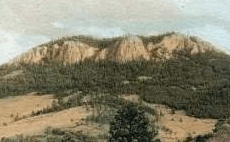
Like the faces of old friends, the limestone cliffs and distinctive silhouette of Mount Helena are heartwarming sights to Helenans past and present. The mountain is a city park, with an excellent trail system. A spectacular view of the Helena Valley can be had from the top, as seen on the MontanaPictures.net website.


Mount Helena from Le Grande Cannon Blvd., ca 1930

Mount Helena from Le Grande Cannon Blvd., ca. 1930


COURTESY OF TOM KILMER

Hiking party wearing suits on Mount Helena, 1911

Looking west from Mount Helena toward Fort Harrison, August 14, 1941


COURTESY OF TOM KILMER

The woman is Hazel Kilmer, who in a few months would join the Women's Army Corps, serving as a parachute rigger in England.


View of Mount Helena from Broadwater, 1965

 
PHOTO BY KENNON BAIRD

1400 block of Cannon St,. 1937


THE WES AND CAROL SYNNESS COLLECTION

This is now near C. R. Anderson School


FORT WILLIAM HENRY HARRISON

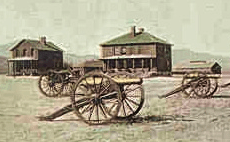
Fort William Henry Harrison, about 1910. Fort Harrison was authorized by an act of Congress in 1892. The Fort was originally named Fort Benjamin Harrison in compliment to the then President. The name was changed in 1906 to eliminate duplication with a fort in Indiana. The military reservation was acquired by donations through the efforts of Col. C.A. Broadwater (who owned the adjoining Broadwater Hotel and Natatorium), the local Optimist Club, and interested private parties.

The Fort was built from 1894 to 1896. In 1895, a detachment of the Hospital Corps from Fort Assinboine south of Havre and several small military posts, which were scheduled to close in the Dakotas, began training at the post. The Montana National Guard began utilizing Fort Harrison for training in 1911, after abandoning Fort Ellis near Bozeman.

Fort Harrison was abandoned and left in the charge of a caretaker by the U.S. Army in 1913. The Montana National Guard occupied the Fort in September 1915, beginning the development of the military post we see today. In June 1916, the Montana National Guard was notified by the War Department to mobilize to guard the U.S./Mexican border. With the start of World War I, the Guard was again trained and mobilized in 1917 to protect major railroad and industrial facilities, until they could be dispatched to eastern camps and eventually overseas. After World War I, the Fort became a Public Health Service hospital and eventually a Veterans Administration medical facility (No. 72). During the first years, it was designated as a tuberculosis hospital and expanded to 300 beds. In 1925, the designation was changed to a general medical and surgical hospital.

After the October 1935 earthquakes that rocked the Helena area, the hospital facility was closed and the patients transferred to facilities in Washington and Oregon. The Hospital facility was reopened in 1937. The Guard continued to use the reservation for training after the earthquake.

During the Second World War, the U.S. Army assumed control of the facility and used it for very new and distinctive military units. These units included the First Special Service Force, the 474th Quartermaster Truck Regiment and the War Dog Training Center (Camp Rimini).


Fist Special Service Force Patch


On April 6 1943, the First Special Service Force paraded down Main St., on their way to the European front...


The 1968 MGM film "The Devil's Brigade" dramatized the WWII exploits of the First Special Service force, which trained at Fort Harrison. The Fort Harrison and other "Helena" footage was shot at Camp Williams near Lehi, Utah. One memorable scene from the film is a barroom brawl between the soldiers and some hard-drinking Helena locals who, for some odd reason, are all dressed like lumberjacks.

Here's a clip from the movie, which shows the Canadian forces arriving at "Fort Harrison"...


Rare token from the Fort Harrison post exchange. Date unknown


Fort Harrison Band, about 1915


Postcard featuring Fort Harrison, published by Helena's A. P Curtin Co., ca. 1900


Fort Harrison, looking NW from the hills, 1923


Original hospital wards


Machine gun on fixed display at the Fort, 1940s


COURTESY OF TOM KILMER

This was on the south side of the circular drive which runs through the campus. Your editor remembers this gun from the mid-1950s.

Since 1947, the Fort has been used for training by numerous active and inactive combats, support and combat service support units. Numerous major improvements and increased training facilities were completed at Fort Harrison in 2001.

Fort Harrison is the site of the Montana State Veterans Cemetery, and the home of the Montana Military Museum.


HELENA SAND & GRAVEL

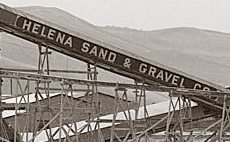
Helena Sand and Gravel had its beginnings in 1929, partially a result of the catastrophic 1928 downtown Helena fire. George Jacoby, son of Charles Jacoby (a 2nd generation contractor, Frank Jacoby and Son) saw the need for clean aggregates for construction and railroad ballast in Montana. He bought 36 acres of tax title gravel land two miles west of Helena, which included the old stone John Stedman Foundry and Machine Company buildings, and utilized the Jacoby Speeder shovel (used in the reconstruction of downtown) to dig for gravel. The resulting pit opened up underground springs, and it soon became an expanding lake.

Helena Sand and Gravel also delivered ready-mixed concrete, and were involved in large building projects in the Helena area. In 1951 Jacoby got into the street paving business with the addition of an Amalga-Pave cold mix asphalt facility.

Jacoby retired in 1955, selling the business to W.A. "Bill" Carson who further carved out the channels and islands of the lake. Carson died in 1964, by which time the gravel had run out. A real estate developer planned to build condos on the site, and called it “Spring Meadow”, but the project was never carried out.

In the early 1980s the State of Montana purchased the property for a State Park. Remnants of the old Helena Sand and Gravel plant, and the earlier Stedman Foundry - the future home of the Montana Wildlife Center - can still be seen.

These beautiful photographs are from the collection of artist and graphic designer Kathryn Fehlig, granddaughter of George Jacoby. Many thanks to Kathy for sharing these wonderful images!


A Jacoby family portrait from about 1922, taken near Lincoln, Montana. Left to right: Charles Jacoby, Frank Jacoby, Dorothy Ann Jacoby, and George Jacoby.

Frank Jacoby was the pioneer, arriving in Helena before 1878. He was a carpenter and formed a company with his son, Charles, called "Frank Jacoby and Son." In 1915 Charles formed a partnership with his brother Frank under the same name. George Jacoby worked for the firm until forming his own business in 1929 (Helena Sand and Gravel).

Frank Jacoby and Son built many buildings in Helena during the first half of the 20th century,
including St. Johns Hospital, the YWCA, the old Western Life building, Shodair Hospital, Colorado Building, LaLonde Block, Granite Block, 7th Avenue Gym, and Carroll College.

This first series of photos was taken in 1929, and show the machinery involved in the process...

Pictured is George Jacoby opening the pit in August of 1929. The Speed Shovel loads a 4 cubic-yard rolling skip..


Overview of the operation, August 1929. At the center left is seen the Speed Shovel and the skip. The loaded skip was pulled up the tracks by an electric hoist housed in the structure with the sloping roof. Once at the top, the contents of the skip was automatically dumped through a grating made of railroad rails set ten inches apart (called a "grizzley").


The skip discharging material through the grizzley, which screened out the very largest stones. The electric hoist is in the wooden structure.


The next step for the material was a trip through this 24½" x 5´ Telsmith Plate Feeder, a three foot by five foot wedge bar grizzley further separated the stones from the gravel. We also see the top of the 10-A primary breaker.


A view of the 10-A primary breaker, and the start of the 20 inch belt conveyor. The breaker and feeder were driven by 40 hp Westinghouse Electric Motor.


View from the hoist, showing material traveling up the 20-inch conveyor belt to the washer. At the right is the six-inch water pipe running from the pump house to the washer. In the background on the right can be seen the old Kessler School, which was damaged in the 1935 earthquakes and subsequently demolished.


The 40 inch by 18 foot Ajax Gravel Washer, seen from the discharge end. It was propelled by a 25 hp motor, which also drove the 20 inch belt conveyor.


Side view of the reduction crusher, which was propelled by 30 hp motor, which also drove the 16-inch belt conveyor which discharged onto the 20 inch belt, taking the product
ofthe reduction crusher.


An overall view of Helena Sand and Gravel, 1929.
CLICK ON PHOTO FOR A LARGE VERSION IN A NEW WINDOW


August 1, 1929.


THE FOLLOWING IMAGES ARE FROM 1936 - 1951, AND SHOW THE GROWTH OF HELENA SAND & GRAVEL

Looking eastward at the operation in 1936. The underground springs had been uncovered.
CLICK ON PHOTO FOR A LARGE VERSION IN A NEW WINDOW


The Helena Sand & Gravel Office, late 1940s.


The Helena Sand & Gravel Office, late 1940s.


Helena Sand & Gravel office interior. The men are unidentified, but the dog is "Major".


The pump house, on the left. Taken January 10, 1939


.

Looking NW at the old Steman Foundry buildings, date unknown.


THE DRAGLINE

The Sauerman Bros. dragline bin and mast, probably 1946.


Part of the Sauerman dragline slack-line cable. Photo by Les Jorud.


The dragline in operation, 1947.


The dragline in operation, 1947.


Helena Sand & Gravel truck fleet, May 13 1948. Photo by Les Jorud. The drivers, from left to right: Tom Plovanich, George Heller, S.L. White, A.C. Storlie, E.J. Kenda.
CLICK ON PHOTO FOR A LARGE VERSION IN A NEW WINDOW


Helena Sand & Gravel Ready-Mixed Concrete plant, about 1952.


The Amalga-Pave plant, about 1952.


Looking west, August 1 1951. CLICK ON PHOTO FOR A LARGE VERSION IN A NEW WINDOW


Eugene Fehlig (left) and George Heller. George Jacoby's only child, a daughter, Dorothy Ann, married Gene Fehlig in 1943. In 1945, Gene joined George in the gravel business and worked there until 1954, when he moved his family back to his home town of St. Louis, Missouri.


Helena Sand & Gravel company picnic on MacDonald Pass, Aug. 6, 1955.
CLICK ON PHOTO FOR A LARGE VERSION IN A NEW WINDOW


SEYMER PARK NEIGHBORHOOD - 1965


Panorama of a Spring Street neighborhood in the Seymer Park (Broadwater) Addition, 1965. The view is to the northeast; Ten Mile Creek is on the far right. Right-click on the photo above to download the full-size1.2 MB file.
PHOTO BY KENNON BAIRD