|
BOOKMARKS
IN THIS SECTION
|
|
|
|
|
|
|
|
|
|
|
|
|
|
|
|
|
|
|
|
|
|
MAIN
STREET OR LAST CHANCE GULCH - WHICH IS IT?
The answer
is: Both. Last Chance Gulch was the name of the actual gulch
in which gold was discovered in 1864. The thoroughfare which
was built down the Gulch was originally named Main Street. It
remained that way for some 85 years, until July 20 1953, when
acting Helena Mayor Dr. Amos R. Little, Jr. signed an ordinance
officially changing the name of Main Street to Last Chance Gulch.
Both names are still used locally for what was once the
grand thoroughfare of Helena's business district.
Last Chance
Gulch meanders as it does because it was originally routed between
mining claims; it was not designed that way to lower fatalities
from stray bullets, as some promotional literature has claimed.
The
images in this section are arranged so that the viewer will
start near the southern end of Last Chance Gulch, and will move
north. The images of each stretch of the street -- like "Broadway
to Sixth" -- will be arranged in chronological order, more
or less.
|

STATE
TO BROADWAY
Last
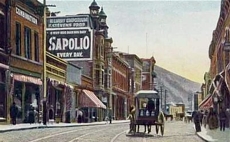
Chance Gulch, 1890s, looking south from Broadway

| Advertised
on the side of the Novelty Block (now demolished) is Sapolio Soap.
Sapolio, started in 1868 in New York City by Enoch Morgan &
Sons, was a pioneering company in the use of mass-marketing, hence
this sign. The brand is still in existence today -- in Peru. The
Sapolio sign was eventually replaced by one for Coca-Cola, which
remained on the building until it was demolished in the 1970s. |


1938
Vigilante Parade on South Main

PHOTO
BY RUTH LYNCH THE WES AND CAROL SYNNESS COLLECTION
|
This photo is courtesy of Carol Lynch Synness, whose family operated
the New Cash Market at 58 South Main. Here, she is being held
by her uncle, John Lynch. |

The
New Cash Market, 58 S. Main, 1938

THE WES AND CAROL SYNNESS COLLECTION
The New
Cash was located next door to the Helena Independent newspaper.
New
Cash Market, 1938 (detail)

THE
WES AND CAROL SYNNESS COLLECTION
| . The lady
holding the balloon is Gwendolyn Lynch. The little girl with her
is her daughter, Kay Lynch. |

Parade
on South Main, 1939

THE
WES AND CAROL SYNNESS COLLECTION
| A
detail from the above image, showing gasoline pumps and rooming
houses on the east side of South Main. Ids'a Rooms (see sign)
was a noted bordello. |

Sisters
Carol and Kay Lynch watching the parade, 1939

THE WES
AND CAROL SYNNESS COLLECTION
| . Across
the street is the New Cash Market, which the Lynch family operated.
The man wearing the apron is Leonard Franks, a partner in the
business. |

BROADWAY
TO SIXTH

| This ca.
1910 postcard shows one of two similar posed 1870 photographs
of Main near the foot of Grand St. It's reasonable to assume that
the version below was taken shortly after this one, because a
larger crowd has gathered. |

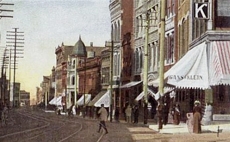
LAST
CHANCE GULCH LOOKING NORTH FROM BROADWAY
Various Views of a frequently photographed corner
Ca.
1890

On the corner is
the Gans (sometimes "Ganz") and Klein clothing store...
Ganz
& Klein trunk label, before 1889

Ca.
1895

Ca.
1900

Ca.
1906

COLLECTION
OF KENNON BAIRD
| High-resolution
scanning of this ca. 1906 "real photo" postcard reveals
some interesting details. On the right is the Parchen Drug Co.,
its sign overlooking Main St. Just visible against the sky is
a streetlight hanging over the intersection of Main and Broadway.
The Gans & Klein "G & K" sign is prominent.
|

| Pabst
Brewing Company promotional sign, featuring the company trade
mark. A recent photo of an identical sign gives us an idea of
how colorful old Last Chance Gulch really was. |
More
details revealed...

| Another Gans
& Klein sign is prominent in this enlargement. The clock hangs
in front of the jewelry store of E. B. Jacquemin & Co., in
the Atlas Block. The company was in business from 1884 to 1933. |

| High-res
scanning also gives us a foreshortened view of Main St. from Edwards
St.north to Sixth Ave. The Securities Building on the right still
stands, but without its decorative cupola. |
Ca.
1915

This postcard
views shows the new seven-story Placer Hotel
Ca.
1920

COLLECTION
OF KENNON BAIRD
Note the electic
Parchen Drugs sign, top right

COLLECTION
OF KENNON BAIRD
Detail of previous
photo, showing businesses near the Placer Hotel.
1950s

1957

COLLECTION
OF KENNON BAIRD
About
1960

This
view taken about 1960 by Lee Goodspeed (1950-2004)

COLLECTION OF NANCY GOODSPEED

THE
SECURITIES BUILDING
Main at Grand

Last Chance
Gulch, about 1900, looking north from Grand St.
| Nearly all
the buildings on the left were destroyed in the fire of July 16,
1928. On the right is the doorway of Samuel T. Hauser's 1886 First
National Bank, long known as the Securities Building. It is still
standing. |
Hauser's
bank in the 1890s...

...and
as it appears now
TWO
PROMINENT BANK BUILDINGS OF OLD
MERCHANTS
NATIONAL BANK MONTANA NATIONAL BANK

A
fancifully-tinted ca. 1900 postcard view of Last Chance Gulch, looking
south from Grand St.
|
Prominent on the right is the (white) 1890 Merchants National
Bank building, and the (yellow) 1883 Montana National Bank
building. On the near left is the red brick Thompson Block,
on the site of the future Placer Hotel. The red building on
the right is the Grand Central Hotel, later the Harvey Hotel.
|
MERCHANTS
NATIONAL BANK - 1890-1898
UNION BANK & TRUST CO. - 1898 - 1959

1890
illustration of the Merchants National Bank building.
|
In November
1865, L H. Hershfield opened a private bank in Last Chance
Gulch, supplementing his bank in Virginia City. Two years
later his brother, Aaron, became associated with him, and
the L. H. Hershfield and Bro. banking house operated as one
of the leading financial firms in the territory until June
10,1882 when it obtained a charter as
the Merchants National Bank of Helena. This bank was located
at 52 South Main which in later years, and until April, 1958,
was occupied by The Independent Record newswpaper.
In 1890 the Merchants National constructed this six-story
bank building on the NW corner of Main and Edwards, where
Helena's second (1872) Masonic Temple once stood. Eight years
later, after the Merchants had suspended business operations,
they sold the building to the newly-organized Union Bank and
Trust Company. The Union Bank maintained its quarters there
for 61 years, moving to a new building at the SW corner of
Lawrence and Last Chance Gulch in July, 1959.
Montana
Power offices then moved into the main floor of the Merchants
National building, and the upper floors were leased as office
space. The handsome structure was demolished in the 1970s,
during Urban Renewal.
|

FROM
THE 1965 LAST CHANCE STAMPEDE PROGRAM COURTESY OF KITTY ANN
QUIGLEY TAALER
Union
Bank & Trust Co. employees, 1920s.
FROM LEFT:
? Mc Connell, Edna Kain, Claude McGuinness,
Irvin Gibson, Ben Draper, Bill Lane, Ed Butler, Frank Ladan.
Union
Bank & Trust Co. Christmas party, December 22, 1949

COURTESY
OF MIKE MILLEGAN CLICK
ON PHOTO FOR A LARGE VERSION IN A NEW WINDOW
MONTANA
NATIONAL BANK
(later
the National Bank of Montana)

1942 view of
the Montana National Bank, Main at Edwards.
| Built by
Charles A. Broadwater in 1886, The Montana National Bank building
stood on the SW corner of Main and Edwards St. Edwards was eliminated
during the 1970s Urban Renewal project. |

1884 newspaper
ad for the Montana National Bank.
Widow
of bank's co-founder perishes in 1944 blaze
 
THE
DAVID HULL COLLECTION
|
The Montana
National Bank building burned on January 10, 1944. Killed
in the blaze were two elderly women, Elizabeth and Laura Clarke,
sisters-in-law who resided in an apartment on the fourth floor.
Elizabeth
Clarke, 81, was the widow of A. G. Clarke, founding Vice President
of the bank. Her sister-in-law Laura Clarke, 83, was the widow
of A. G.'s brother, Will.
Eight
others were injured in the fire, several critically.
|

Fourth
of July Parade on Last Chance Gulch, looking north from Grand St.,
ca. 1890


Ca.
1900 view of Main St. from atop the Power Block

CLICK
ON IMAGE FOR A LARGER VIEW IN A NEW WINDOW
| Only three
structures pictured here still stand: the fire tower, the Atlas
Block, and the Securities Building. |

Last
Chance Gulch, 1890s, looking south from 6th Ave.


THE
POWER BUILDING aka POWER BLOCK

| Built to
last in 1889 by magnate Thomas C. Power, The Power Building still
presides over the intersection of Sixth and Main in downtown Helena.
Although it has long been known as the Power Block, the original
keystone over the Sixth Ave. entrance has carved into it "Power
Building". |

1890 illustration
of the Power Block. A feed stable previously occupied the site.

Interior
of the Power Block, 1970

PHOTO
BY KENNON BAIRD

Last
Chance Gulch, ca 1915, looking south across 6th Ave.


A WWI-era
parade on Last Chance Gulch.

If anyone can date
this image more precisely, please send
me an e-mail.

Last
Chance Gulch, 1920s, looking south from 6th Ave.


Last
Chance Gulch, 1930s, looking north from Edwards St.

THE
DAVID HULL COLLECTION

Shriner
hijinks in front of the Placer Hotel, late 1940s...

COLLECTION OF KENNON BAIRD

Detail of previous
image. Anybody know what's going on?

Last
Chance Gulch, looking south from near Grand St., 1922

THE
WES AND CAROL SYNNESS COLLECTION

Last
Chance Gulch, looking north across 6th Ave., 1920s

THE
WES AND CAROL SYNNESS COLLECTION
| Prominent
on the right is the 1880s Beveredge Block. Many will recall Jacoby's
Store for Men and the Thistlewaite Shoe Co. in that location. |
|
|
|
Some Helena
Baby-Boomers will remember, as I do, placing their young feet
in Thistlewaite's
X-ray shoe-fitting machine, a hazardous sales gimmick which
was banned from the marketplace by the 1960s.
It's interesting,
and a little scary, that the newspaper ad states that there's
no charge to use the machine, and that people should come in
and "Use it freely...whether you're ready to buy or not".
Soaking up X-rays just for fun isn't a good idea.

|
|
|
|
THE
FIRE OF 1928


|
|
|
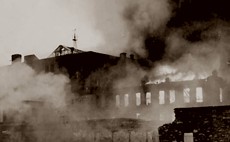
In
the early-morning hours of July 16 1928, flames erupted from
28 N. Main St., the building which housed the Curtis Cafe and
the Maverick Pool Hall. The rapidly-spreading fire was discovered
and reported at 2:00am by Johnny Bukowitz, a printer at the
Helena Independent newspaper, who happened to be passing the
cafe.
No
sooner had the Helena Fire Department responded to the blaze
than a torrential hour-long rainstorm began, hampering firefighting
efforts but wetting nearby roofs, preventing an even greater
catastrophe. Roomers in the adjacent buildings fled into the
streets, where they were soon soaked to the skin by the downpour.
The storm brought with it shifting winds, which threatened to
carry embers in every direction. Frequent lightening bolts illuminated
the surreal scene.
In
two hours time, the fire was completely out of control, and
had spread north destroying numerous businesses. It also crossed
over to the east side of Main St., damaging several buildings.
Firefighters began concentrating their efforts on saving buildings
on Sixth Avenue and the east side of Main. Shop owners and other
businessmen hurriedly carried goods, equipment and records from
threatened buildings. Explosions were heard when the blaze touched
off chemicals stored at the Budd-Fisher Drug Co. The Western
Union lines were severed by the fire.
By
6:00am the fire was brought under control, but had destroyed
several large commercial buildings housing dozens of businesses.
The Granite, Bailey, Gold, and New York Store blocks were reduced
to rubble; the Power Block, the A. P. Curtin Block, the Pittsburgh
Block, and several other buildings were damaged.
The
blaze was far beyond the power of the Helena Fire Department
to cope with; water pressure was adequate, but too few hoses
and too few men could be brought to bear.
|
|
|


FROM
THE 1965 LAST CHANCE STAMPEDE PROGRAM COURTESY OF KITTY ANN
QUIGLEY TAALER
After the fire,
looking east toward the Pittsburgh Block.

1942 photo showing
the rebuilt block.

Last
Chance Gulch, 1940s, looking north from Edwards St.


Shriners
on parade, late 1940s

COLLECTION
OF KENNON BAIRD
CLICK PHOTO TO OPEN A LARGE VERSION IN
A NEW WINDOW

Last
Chance Gulch, looking south, early 1950s

COLLECTION
OF KENNON BAIRD

A SUMMER
EVENING IN DOWNTOWN HELENA, ca. 1954

COLLECTION
OF KENNON BAIRD CLICK IMAGE TO OPEN LARGE
VERSION IN NEW WINDOW

West
side of Last Chance Gulch, looking south, about 1954

COLLECTION
OF ED MCKNIGHT

Last
Chance Gulch, looking north, mid-1950s

|
The bustling
two-way traffic on the Gulch, and the abundance and variety
of stores are enough to bring a tear to an old Helenan's eye.
Notice that
Woolworth's had by that time replaced their striped canvas awning
and classic red and gold sign with a charmless aluminum and
plastic soffit.
|
REPAVING
MAIN ST., 1958

COURTESY
OF SCOTT NELSON - THE
BRIDGEWORKS CONSERVANCY
|
This extensive
asphalt repaving and sewer repair project also removed the streetcar
rails and underlaying 1905 brick paving.
Main Street
was first paved in 1892, with hot coal tar over a macadam base.
In 1905, the stretch between Cutler Street north to Helena Avenue
was paved with bricks.
In the above
photo, the man in khaki, with hands hips, is James Nelson. The
cement truck on the right is still in operation today.
|

Looking
north on Main, ca. 1960

|
Many of the business on the left - the Martha Hotel, Higgins Cigar
Store, Matt's Club, etc. - were destroyed by fire in the 1960s.
Communtiy Transit cabs were dispatched from the Placer Hotel,
on the right. |
 

Last
Chance Gulch, ca. 1963, looking north

|
The Cabin
Cafe had by then become Bryant's, and a prominent "Kuppenheimer"
had been added to the Anderson Clothing sign.
|

An early
1970s postcard view

|
The
aluminum-sheathed strorefront on the right was the C. R. Anthony
Co., an Oklahoma-based retail chain.
|

Shriners
parading up Main St., late 1940s

COLLECTION
OF KENNON BAIRD

An eary
1970s view, looking north across Sixth Avenue

COLLECTION
OF KENNON BAIRD
| All but
one of the buildings on the right (the tall Goodkind Building)
were soon to be demolished by the Urban Renewal Project. Does
anyone else remember getting hot nuts from the rotating dispay
case in the front window of Saveway Drug? |

SIXTH
TO LAWRENCE

|
A
beautiful summer morning in the 300 block of Main St., ca. 1900,
looking south across Sixth Avenue.
|

Sixth
Ave. at Main, looking west, ca. 1909

The Power Block
is on the left, the Ashby Block on the right, and the Horsky Block
on the far right.

Sixth
Ave. at Main, looking west, 1920s

| The
building on the right, The Ashby Block, was demolished in the
1930s to make way for the First National Bank building. Note the
multi-globe streetlights; they would soon be replaced by lights
of a newer but less attractive design. |

THE MONTANA
CLUB
The
second Montana Club building, Sixth and Fuller, about 1915

COURTESY
OF BLAKE GARDINER

Sixth Ave. looking
west from Main St., 1930s

COLLECTION
OF KENNON BAIRD
You may wonder
where all the parking meters are. They were not installed in Helena
until January of 1946. The Independent Record reported
in 1956 that 400 lbs. of "slugs, washers,
bus tokens, trade checks and electrical box knockouts" had
been recovered from the meters. |

The
Tour Train on Sixth Ave. near Last Chance Gulch, 1957

COLLECTION
OF KENNON BAIRD

1937
Vigilante Parade float ("Old-Fashioned Living Room") 300
block of N. Main

THE
WES AND CAROL SYNNESS COLLECTION

Last
Chance Gulch, late 1940s, looking south across Sixth Avenue

|
The Safeway
market, seen here on the left in the former Helena Meat Co.
building, would soon move to the NE corner of Placer and Fuller;
the Ben Franklin variety store would subsequently occupy this
space.
Also seen
on the left are Gamble's, Singer Sewing Machines, and Parchen
Drug. On the right are the First National Bank, the J. C. Penney
Co., and - in the Power Block - Goldberg's Furriers.
|

300
block of N. Last Chance Gulch, 1950s, looking south

COLLECTION
OF KENNON BAIRD
| On the left
are the Mecca Cafe and Scott's Toys. On the right we see Helena
Hardware, the Elks Lodge (upstairs), Jorud Photo Shop, Palace
Clothing, and the Silver Spur Lounge (which later became O'Toole's). |

300
block of N. Last Chance Gulch, 1963 Last Chance Stampede Parade

COURTESY
OF KITTY ANN QUIGLEY TAALER

THE UNION
BANK WEATHER BALL
COURTESY
OF KITTY ANN QUIGLEY TAALER
Enlarged detail of previous image, 300 block of N. Last Chance Gulch,
1963
|
|
|
At top center
is the Union Bank "Weather Ball", a white translucent
sphere which gave the latest weather forecast at night via colored-coded
lights inside. The bank's often-played radio jingle gave the
code, and permanently emplanted itself in the brains of a generation
of Helenans:
"Union
Weather Ball red as fire, the temperature is going higher.
Union Weather Ball white as snow, down
the temperature will go.
When the Weather Ball is green, no change
in temperature is foreseen.
Weather Ball flashing night
or day, rain or snow is on the way."
|
|
|

Union Bank
newspaper ad featuring the Weatherball, 1960.

COURTESY
OF TOM KILMER
Souvenir ashtray,
given out when the new Union Bank building opened in 1959.

1970s
postcard view of Last Chance Gulch, looking north

|
There may
be an uglier postcard of Helena, but I've never seen it. Now
known as the Donovan Building, the boxy 1963 J. C. Penny Co.
store was designed by Portland architects Edmondson & Kochendoerfer.
In the summer of 2008, a second
story was added to the structure...
|

INDEPENDENT
RECORD PHOTO BY ELIZA WILEY

Budweiser
Clydesdales, 1964 Last Chance Stampede Parade

COURTESY
OF TOM KILMER
|
Note the rough pine-bark façades on The Globe Clothing
Co. and Barnes Jewelry. Many Helena businesses sported these during
the Centennial year of 1964. This had previously been done in
1949, during "Golden Canyon Days", a celebration of
the 60th year of Montana statehood. |
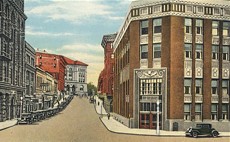
Beer
wagon, 1964 Last Chance Stampede Parade

COURTESY
OF TOM KILMER
On the far right
is the 1934 Rio/Vigilante Theater building, still standing today.

View
from W. Lawrence and Fuller, 1964

COLLECTION
OF KENNON BAIRD
| Notice the
split log stockade-type structure on the right. This was "Fort
Union" behind the Union Bank & Trust Co., one of many
such rustic decorative structures put up during 1964 as part of
Montana's Territorial Centennial celebration... |

FROM
THE 1964 LAST CHANCE STAMPEDE PROGRAM COURTESY OF KITTY ANN
QUIGLEY TAALER

Lawrence
at Fuller, 1970s site of the old Y. M. C. A.

The same view ca. 1915.

LAWRENCE ST. TO
NEILL AVE.
400
block of N. Main, 1950s
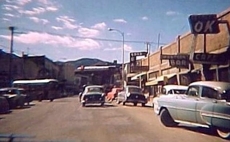
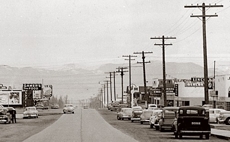
Prominent in this
rare view is George's OK Cafe.

Main
News & Confectionery, 407 N. Main, 1980
PHOTO BY KENNON BAIRD
|
|
|
For many
years, Main News was operated by Mr. Harry Stone (1893 - 1972).
He stocked a wide variety of magazines, newspapers, comic books,
penny candy, pop, cigars, pipes, fishing reels, knives... You
could also get your fishing and hunting licenses there. It was
a wonderful place to go; indeed, it was a window to the outside
world, and also to the world of fantasy.
My lasting
memories of Main News include the smell of new comic books and
magazines, the array of colorful penny candy in the deep oak
showcase, and the taste of cream soda sipped through a paper
straw. There were shelves of cigars in open boxes, with beautifully
printed pictorial labels on the lids. Rows of sharp new jackknives
covered a showcase shelf.
Mr. Stone
would let customers use the ancient restroom in the rear of
the store; it was the kind with the tank mounted on the wall
high above the toilet, with a long flush-chain hanging down.
It made a terrific noise.
Harry Stone
looked a bit like President Eisenhower, and usually wore a bolo
tie with an agate stone. He was always nice.
Thank you,
Harry.
|
|
|

Shops
in the 1888 Iron Front Building, 1970's
PHOTO
BY VIRGIE MILLEGAN BAIRD COLLECTION OF KENNON BAIRD
The
façade of the Iron Front Building was cast locally at the Stedman
Foundry.

The
Steamboat Block
N.
Main at Neill Ave., looking north, late 1950s

COURTESY
OF DARCY O'DELL
|
The Conoco station was owned by Al Rose, who still has a garage
in Helena. At far right center is the "Just Good Food"
sign for the Peter Pan Drive Inn. Dominating the scene is the
Steamboat Block, built in the 1870s by shipping magnate and politician
Thomas C. Power. The building has been significantly altered,
as evidenced by the period illustration below. |


NEILL
TO LYNDALE

COLLECTION
OF NANCY GOODSPEED
800 block of
N. Main, looking north, early 1950s
| On the left
is the Walt Holland used car lot. On the right (east side) of
Main, is Rock Hand & Co., dealers in farm equipment and hardware. |

Reber
Plumbing & Heating Co., 805 N. Main, 1951

COURTESY
OF KATHRYN FEHLIG

THE
1942 MONTANA NATIONAL GUARD ARMORY
1100
N. Last Chance Gulch at Lyndale

|
Built to
replace the Warren St. Arsenal which was destroyed in the 1935
earthquakes, this building is now occupied by State of Montana
offices.
|
The
Armory under construction, 1942

THE
WES AND CAROL SYNNESS COLLECTION
|
|
|
For many
years, traveling shows, such as the Siebrand Bros. Circus and
Carnival, would set up on the large open area behind the Armory.
In September of 1953, the Ringling Bros. and Barnum & Bailry
Circus set up their big top.


|
|
|
|