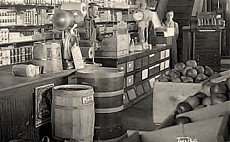
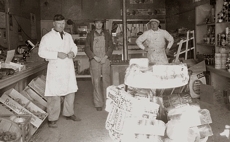
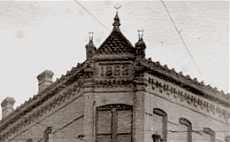
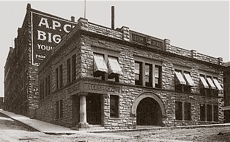
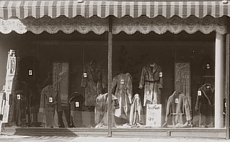
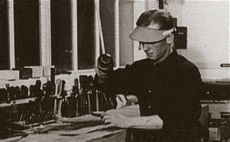
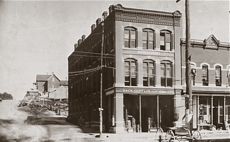
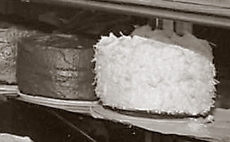
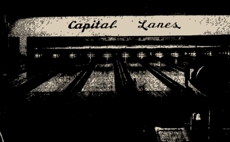
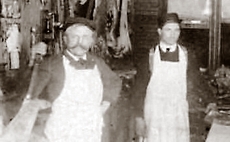
Interior of an unknown Helena mercantile, ca. 1900


Interior of an unknown Helena area mercantile, 1907
Photo by Edward M. Reinig

Edward M. Reinig was a professional photographer who operated a small commercial studio in the basement of his Helena home. His photographs include views of Helena and the nearby towns of Elliston, Marysville and Radersburg. Although this store may have been in one of those outlying communities, it is typical of the everyday Helena shopping experience at the beginning of the 20th Century.


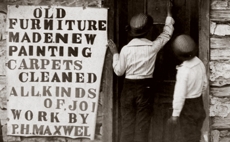
Unknown Helena furniture store, ca. 1890


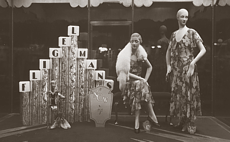
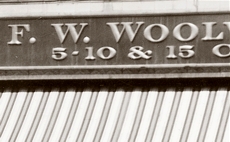
Unknown variety store, 1929


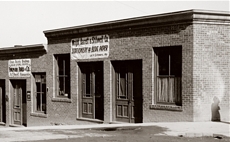
The New Cash Market • 58 South Main


THE WES AND CAROL SYNNESS COLLECTION


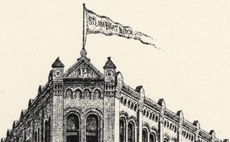
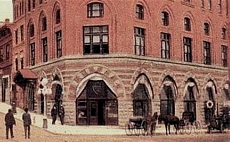
THE ASHBY BLOCK
Sixth and Main
1883-1929

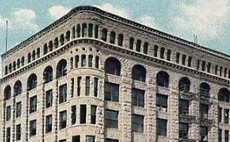
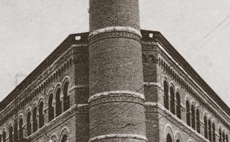
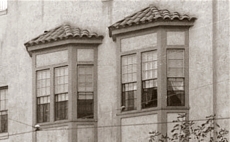
The Ashby Block, northwest corner of 6th and Main, 1919. Built by S. C. Ashby and Charles A. Broadwater in 1883, it was demolished in 1929 to make way for the First National Bank Building. The corner windows of the Ashby Block were popular perches for photgraphers, who documented numerous parades on the Gulch from there.


ROCKY MOUNTAIN TELEPHONE COMPANY
Jackson and Grand

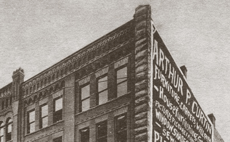
The 1897 Rocky Mountain Telephone Company building, SE corner of Grand St. and Jackson. Behind it is the A. P. Curtin Store on Grand St. A third floor and addition to the back of the building were constructed in the early 1920s.

For many years this building served as Montana headquarters for Rocky Mountain Bell, and
contained the business office, long distance and local service operators for the manually operated central office. It housed equipment and personnel to maintain the Northern Transcontinental Toll Line extending east to west across Montana, and the Helena-Salt Lake and Helena-Calgary long distance networks.

Telephone operators, the business office and most maintenance personnel were moved to
the dial exchange building at 441 N. Park following inauguration of dial service in 1955.
In January of 1962, all state administralive offices together with engineering and accounting
departments were consolidated in the present state headquarters building, purchased by the
telephone firm from Western Life.

All equipment was removed from the Jackson St. building in 1966.


The footprint of the RMTC building superimposed on a recent satellite photo. Grand Street, which connected Main to N. Warren, no longer exists.


APARTMENTS AT 426 CLARKE ST.
1887 - Today

This apartment building, still standing at 426 Clarke St., was built in 1887 by Sarah E. Spalding.


Sarah E. Spaulding and her daughter Lena Griggs Curtiss Gunn (b. Kansas 1872). They came to Helena in 1876. Twice-widowed Sarah was one of the original incorporators of the Helena Florence Crittenton Home. Lena was talented in drawing.


A Chinese peddler on the steps of 426 Clarke St., probably 1901. The little girl is Maebelle Gunn, Mrs. Spalding's grandaughter. In 1926, Maebelle portrayed Yu Chin in the Chinese play "Mrs. Li Remembers", given for charity at the Congregational Church.

Many thanks to Pam Attardo of Clarke St. in Helena for these beautiful photos and information, which she received from from Mrs. Spalding's great-grandson, Phil Gunn, who now lives in Arizonawith his mystery novelist wife, Elizabeth.


THE BONNEVILLE APARTMENTS
Park Ave. and Lawrence
1875-1988


COURTESY OF JEFF SHERLOCK

The Bonneville Apartments under demolition, NE corner of Park and Lawrence, 1988. The Bonneville was built in 1875, and remodeled around 1926 in the Mission Style. Colorful mosaic tiles decorated the floor of the Park Ave. entryway, and several light wells brightened the interior. There was no elevator; a wide central stairwell served three floors, and a long flight of narrow back stairs led down to the parking lot on the east side. Coal for the large furnace in the basement was delivered via a chute on the Lawrence (south) side of the building.

This great view was taken from the City-County (old Federal) Building by Jeff Sherlock.

The east side of the Bonneville Apts, ca.1913.


THE HOMER BLOCK
Later known as the Central View Apartments
Park Ave. and Clarke
1890-1971


COLLECTION OF KENNON BAIRD

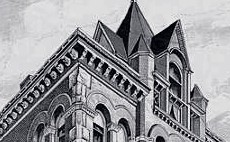
The 1890 Homer Block, SW corner of Park Ave. and Clarke St., early 1940s. This ornate building had apartments on the upper floors, and offices on the ground floor. Dressmakers, physicians, lawyers, music teachers and others rented commercial space there over the years. From 1906 to 1915, the Christian Science Reading Room was located in the Homer Block.

Beginning about 1932, the building was named the Central View Apartments. It stood until 1971, when it was one of the first Victorian structures in Helena to fall to the Urban Renewal wrecking ball. Older Helenans will remember the carved griffins above the corner doors...


The footprint of the Homer Block superimposed on a recent satellite image. A widened Park Ave. now cuts through part of the site.


HELENA PUBLIC LIBRARY & AUDITORIUM
1897- 1935
7th Ave. at N. Warren St.
Damaged by the '35 earthquakes and subsequently demolished


COLLECTION OF KENNON BAIRD • CLICK ON IMAGE FOR A LARGER VERSION IN A NEW WINDOW

The 1897 Helena Public Library and auditorium, located at 7th and Warren. It was heavily damaged by the 1935 earthquakes, at which time the books and other materials were moved to the vacant Unitarian Church at Park and Lawrence. That building subsequently served as the library for over 30 years, and is now the Grandstreet Theatre.

The adjacent 1908 Seventh Avenue Gym, the red-roofed building seen in the satellite image below, still survives.


DETAIL OF PREVIOUS PHOTO


The footprint of the old library and auditorium superimposed on a recent satellite image


COLLECTION OF KENNON BAIRD


Y. M. C. A.
Fuller and Lawrence
1914 - 1970s


COLLECTION OF KENNON BAIRD

The 1914 Y.M.C.A building, on the SE corner of Fuller and Lawrence. It was demolished in the 1970s, during the Urban Renewal period.

Immediately following the 1935 earthquakes, several City of Helena offices were temporarily housed in the Y. M. C. A. buil


PHOTO BY VIRGIE MILLEGAN BAIRD - COLLECTION OF KENNON BAIRD

A 1970s view of the same corner.


COURTESY OF SCOTT NELSON

A recent view of the site. The Y.M.C.A. cornerstone is preserved in a section of brick wall...


Y. W. C. A.
Park Ave. and Placer
1918 - Today

The 1918 Y.W.C.A., seen from Park Ave. Still standing, still in business.


COURTESY OF KATHRYN FEHLIG

The Y.W.C.A., seen from Fuller Ave., 1951.


MONTANA CHILDREN'S HOME SOCIETY
840 Helena Avenue


COLLECTION OF KENNON BAIRD

The Receiving Home of the Montana Children's Home Society, on Helena Ave., about 1917. It still stands, next to the old Shodair Children's Hospital. Shodair began as a home for orphaned and abandoned children in 1896. Children would be placed on "orphan trains" in the south and sent to the northwest. If they were not adopted at one of the stops along the way, they would end up in Helena, the last stop. Montana Children's Home and Hospital was developed to care for these children. It was later renamed Shodair Children's Hospital after benefactor Louis Shodair.


COLLECTION OF NANCY GOODSPEED

The Receiving Home today.


PRESS ROOM OF THE HELENA INDEPENDENT NEWSPAPER

52 South Main
About 1918


COURTESY OF SCOTT NELSON - THE BRIDGEWORKS CONSERVANCY

Press room of the Helena Indpendent, about 1918. Second from the left is Bill Stephenson, tending the Goss press. Health problems caused by prolonged exposure to lead type and certain inks plagued typesetters and pressmen. • CLICK IMAGE TO ENLARGE •

Helena Independent front page logo, 1918.


GLOBE CLOTHING
361 N. Main
In business from 1909 to 1984


FROM THE 1964 LAST CHANCE STAMPEDE PROGRAM • COURTESY OF KITTY ANN QUIGLEY TAALER

Now the site of Bert & Ernie's Dining Saloon & Grill on the SE corner of Main and Lawrence, Globe Clothing -- later "The Globe" -- operated from 1909 to 1984. The building was enlarged/remodeled several times, most notably in 1940 and again 1960, when the adjacent vacant Ideal Bakery space at 363 N. Main was incorporated.


FROM THE 1965 LAST CHANCE STAMPEDE PROGRAM • COURTESY OF KITTY ANN QUIGLEY TAALER
Interior of Globe Clothing & Jewelry, March 1913.


The Globe in 1964.


THE MONTANA NATIONAL GUARD ARSENAL
600 N. Warren
1890 - 1935

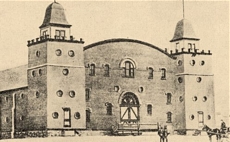
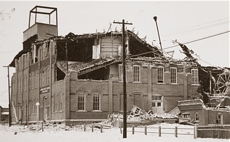
The Montana National Guard Arsenal was formally opened May 9 1890. It was extensively damaged by the 1935 earhquakes, and subsequently demolished.


Footprint of the 1890 arsenal superimposed on a recent satellite image.


THE WES AND CAROL SYNNESS COLLECTION


COLLECTION OF KENNON BAIRD

Destruction of the Montana Arsenal caused by the 1935 earthquakes. Because the equipment stored within the arsenal was so well-packed, it all went undamaged during the quakes. One officer, Major Sol Peterson, was injured by the collapse. Construction of the new Armory, at the intersection of N. Main and Lyndale, began in 1940. That building now houses State offices.


NATIONAL BISCUIT COMPANY
1308 Boulder Ave.
(Construction date unknown) - A casualty of the 1935 earthquakes


THE WES AND CAROL SYNNESS COLLECTION

Ruins of the National Biscuit Company factory on Boulder Ave. The Sixth Ward (depot district) where this building was located, was the hardest hit by the 1935 quakes. At the time of the quakes, this facility functioned primarily as a distribution center.


HELENA BRANCH OF THE MINNEAPOLIS FEDERAL RESERVE BANK
400 N. Park Ave.
1937 - today

The flower-bedecked lobby of the old Federal Reserve Branch Bank, Park Ave. at Lawrence. Photo taken on the bank's opening day, June 17, 1938.

The building was constructed in 1937 and served as the Federal Reserve Bank until 1990. It was remodeled in 1991 to accommodate offices on the upper and lower level, and First Montana Title Company on the main level. The remodeling process was careful to preserve the character and detail of the building. Now called the Reserve Financial Center, it is still home to 4 major vaults and 34 smaller vaults throughout the building.


RADIO SERVICE ENGINEERS
LATER CHARLTON RADIO & ELECTRIC

352 N. Main
Building burned in 1950


John Howell Clarke and Mildred Getts Clarke, 1934
COURTESY OF ROWENA CLARKE FULK

In 1934, John Howell Clarke and his bride Mildred Getts Clarke, moved to Helena from Great Falls, where Howell (as he preferred to be known) took over the radio repair service of local Philco dealers Burgan & Walker, who were located at 431 Fuller Avenue...


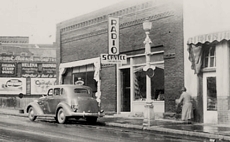
In 1935, Mr. Clarke opened Radio Service Engineers at 352 N. Main, pictured below. This brick building was located where the entrance to Wells Fargo (once the Union Bank & Trust Co.) is today.

About 1938, J. H. Clarke sold the business to his sister and brother-on-law, Virginia and Earl Charlton. The Charltons operated in Helena for many years selling radios, pianos, organs, and appliances.


COURTESY OF ROWENA CLARKE FULK

The J. H. Clarke shop, 352 N. Main, 1935.


COURTESY OF ROWENA CLARKE FULK

The J. H. Clarke shop, 352 N. Main, 1935.


COURTESY OF ROWENA CLARKE FULK

J. H. Clarke discarding bad radios at the city dump in the Helena Valley, about 1935. Note the axe used to chop them up. Electronics recycling has improved since then.


COURTESY OF ROWENA CLARKE FULK

Earl Charlton in front of the business at 352 N. Main, shortly after purchasing it from J. H. Clarke. The Charltons moved the shop north to 424 N. Main sometime before 1953.

In October of 1950, this brick building (350 and 352 N. Main) was gutted by fire, destroying the Super Ice Cream Factory at 350, and heavily damaging the Susan Eaker Book Shop, which then occupied 352. The building was pulled down. Eaker reopened her shop in 1951 at 29 W. 6th Ave.


BROADWATER GROCERY
ONE ROBBER KILLED, TWO IMPRISIONED, IN 1939


COURTESY OF SCOTT NELSON • THE BRIDGEWORKS CONSERVANCY

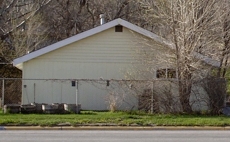
Above is a 2008 photo of what remains of the Broadwater Grocery. From 1935 to 1967, it was a handy stop at the Highway 12 / Williams St. intersection west of Helena, supplying groceries, beer and, for a time, gasoline. Only the rear residence part of the building remains, the front retail section having been removed when the highway was widened in the 1960s. Thanks to preservation-minded Scott Nelson for this photo!

The intersection has long been a lively one. It was across the road from the Broadwater Hotel and Natatorium, and a mile from Fort Harrison -- which made it a handy R&R stop for military men. Two raucus roadhouses, several service stations and two restaurants operated near the crossroads over the decades. Like almost everywhere in Montana before the 1940s, gambling was a staple in these establishments.


The footprint of the Broadwater Grocery's retail section superimposed on a recent satellite image.

Broadwater Grocery Ad, 1953

Your editor admits to a nostalgic fondness for the Broadwater Grocery, having grown up in the neighborhood from 1950 to 1969. When I was first aware of the store, around 1954, it was owned by Tom and Lucille Root; it was always a treat when my dad would say, "Let's go see Tom", because I knew that cold pop, candy or maybe even fireworks were in the offing. The store was the favorite destination of every neighborhood boy I knew, and we spent a lot of silver there during our growing-up years.

The Roots sold out in 1955 to Tony and Jane Schultz, who operated it until 1967, when the widening of the highway forced them to close. The front of the store was removed, but I believe the Schultzs continued to live in the residence for some time.

The builder of the enterprise, Fred "Scotty" Palmer, retired in 1943, selling to Alberto and Gladys Whitney. They sold to Herman and Vi Rupp in 1950, who in turn sold to Tom Root in 1952. At least that's as close as I can track it.

If anyone has photos of the Broadwater Grocery, please contact me.

Now for the exciting part...


BUILDER OF THE BROADWATER GROCERY SHOOTS AND KILLS ROBBER - 1939
CONDENSED FROM THE ARCHIVES OF THE HELENA INDEPENDENT

On Saturday, March 11 1939, three experienced slot-machine hijackers from Butte, Montana drove to Helena in a Dodge coupe, looking for places to rob. William Foster (1910-1939), Elwood Burton Crawford (1910-1966), and Edward "Babe" Netterberg (1906-1973) cruised the area for hours, until about 10:00 pm, when they stopped at the Broadwater store.

Foster went inside, bought a pack of cigarettes from owner Fred "Scotty" Palmer (1876-1969) and loitered for a few minutes, casing the place. Foster decided that the Broadwater Grocery and filling station looked like an easy target.

The trio decided to wait until the following morning to hit the store, intending to surprise Palmer when he opened up. To kill time, the boys spent the night driving to East Helena, then to Townsend and back, looking for future holdup opportunities.

They returned to Broadwater around 6:00 am on Sunday morning, and parked on "an upper road and about a quarter mile east of the gas station" (presumably Hauser Blvd., which at that time went through to the highway) and waited for the owner Fred "Scotty" Palmer to open up. When they saw the store lights come on, they drove down...


Netterberg remained in the car as the getaway driver, while Foster led the way into the store with Crawford close behind him. Foster thrust his hand into the pocket of his dark blue overcoat, in which was a loaded .38 revolver, and told Palmer, ""This is a stickup! These slot machines have to go, Dad." To which Palmer replied, "O. K.".

While Foster kept his revolver trained on Palmer, Crawford took the nickel machine and loaded it into the Dodge. He came back, picked up the dime machine, and took it outside.

Foster then turned away from Palmer momentarily to grab the cash drawer. Palmer backed away from Foster, toward a bedroom at the rear of the store (the part of the structure existing today). Palmer reached around a door sill and grabbed a 12-gauge Remington automatic shotgun which was leaning against the wall. When Foster turned around holding the cash drawer, Palmer fired. He was less than 12 feet away from Foster when he pulled the trigger. The blast of shot ripped away part of Foster's left sleeve, blew a four-inch-wide hole in the front of his overcoat, and entered his body just under the heart.

"Oh!" Foster cried, dropping the cash drawer to the floor, scattering the $10 in change that it held. He fell to the floor, got up, staggered out the door, and fell again. Crawford, outside with the dime slot machine, dropped it and ran north toward Ten Mile Creek. Netterberg exited the car and hid, crouching next to the building.

Palmer went outside with his shotgun and confronted Netterberg, who pleaded with Palmer not to shoot him. Palmer marched Netterberg across the highway to the Pepperbox (now the Corner Bar), where bartender Leonard Floydell called the Sheriff and ambulance, and held Netterberg until the Sheriff arrived.

Foster was taken by ambulance to St. John's Hospital, where he died less than four hours later of shock and hemorrhage.

Crawford hid in an outhouse near Ten Mile Creek, in back of the Pepperbox, but was found a short time later by Sheriff Brian O'Connell.

In the Dodge were found several homemade blackjacks, and wiring which authorities said was similar to that used in blowing open safes.

A coroner's jury found that Palmer's shooting of Foster was justifiable. Crawford and Netterberg were each sentenced to three years in the state penitentiary. Foster was buried in Butte's Holy Cross Cemetery.

"I'm sorry this thing had to happen," Palmer said in The Helena Independent. "But when this fellow pointed a gun at me and was trying to steal my money there was only one thing I could do—and that was protect my property. I knew he meant business. The way he told me it was a stuck-up was without any sign of nervousness. And when he took my cash drawer, with money I worked hard to earn, I Just bad to do something about protecting myself."


MUTUAL COAL CO.
Railroad Ave. at Lamborn


COURTESY OF BOB GUFFEY

The office of the Mutual Coal Co., corner of Railroad Ave. and Lamborn St., 1930s. The scale was located between the office and the coal bins -- the buildings where the "hauling & storage" sign is.

The small sign by the office door is for Jeffries Coal, which was mined near Roundup, Montana.

These wonderful photos are courtesy of Bob Guffey, grandson of Mutual Coal Company owner, Ora Guffey. Thanks, Bob!


The location of the Mutual Coal Co., superimposed on a recent satellite image. Located here were the small office, scale, and coal bins. The truck fleet was housed in a garage (seen below) but I am presently unsure of its location, other than it was also in the Sixth Ward.


In 1927, Bear Creek Mutual Coal became the Helena Mutual Coal Company . The name was later changed to the Mutual Coal Company.


COURTESY OF BOB GUFFEY

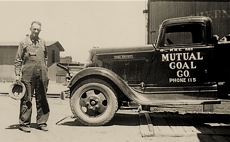
Ora Guffey (1892-1981), owner of the Mutual Coal Co. Mr. Guffey had other Helena interests over the years, including selling real estate and operating the Ora Guffey Trading Post, dealing in all manner of goods.


COURTESY OF BOB GUFFEY

Ora and Nellie Guffey, with the truck fleet in front of the garage.


Coal was branded and marketed on a retail level in those days, and was sold by the ton in various sizes -- like "lump". "egg" and "nut".


COURTESY OF BOB GUFFEY

The truck fleet and drivers.


COURTESY OF BOB GUFFEY

Drivers identified as Earl and Joe


COURTESY OF BOB GUFFEY

Damage to the garage after the first of the 1935 earthquakes...


COURTESY OF BOB GUFFEY

Damage to the garage a few days later, after the final 1935 earthquake.


The above Independent Record story about the earthquake damage contains a small error, in that Consumer's Coal was a different company, in competition with Mutual Coal.

In later years, as the use of coal declined, Ora Guffey transitioned the business into a kind of general mercantile, operating the Ora Guffey Trading Post at Lyndale and N. Oakes, also in the Sixth Ward.


BUTTREY'S SUPER MARKET
648 N. Jackson
1938 - today


THE WES AND CAROL SYNNESS COLLECTION

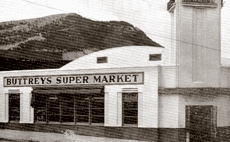
This art deco building at Jackson and 13th has seen numerous tenants over the decades. In this 1949 photo, we see it as Buttrey's Super Market. The structure was built in 1938 by Ellis Blumenthal, who opened his Nuway Super Market there on November 19. Less than a year later, he sold out to the Buttrey's chain, who held their grand opening in Helena on August 18, 1939 (see newspaper ad below). It was the 16th store in the Buttrey's chain.

Buttrey's was founded in 1906, and had numerous stores along northern Montana's "High Line", which is the name given to the east-west route followed by U.S. Highway 2 and the Great Northern Railway line.

In the mid-1950s, Buttrey's moved to the new Hustad Shopping Center on Helena Ave., and later to a new large Buttrey-Osco store on Montana Ave. For a detailed history of Buttrey's, click here.

This building has also served as the Moose Lodge and as the bus depot.


TOWER FOOD MART and TOWER SHOPPING CENTER
1220 11th Ave.


THE WES AND CAROL SYNNESS COLLECTION

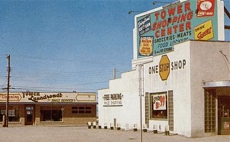
Tower Food Mart, 1220 11th Avenue, 1940s. The market was so named for its close proximity to the KXLJ radio broadcasting studio and tower at 1306 11th Avenue.

On Ocober 25, 1950, a grand opening was held for the expanded Tower Shopping Center, which included a variety store, and frozen food locker plant. In 1956, more shops were constructed on the north side of the lot.


Helena Independent-Record display ad for the Tower Food Mart, May 23 1946. An inferior brand of flour raises havoc in the kitchen. CLICK TO ENLARGE


Helena Independent-Record story about the expanded Tower Shopping Center Grand Opening , Oct. 24 1950.
CLICK TO ENLARGE


COURTESY OF D. R. STINSON

Postcard view of the Tower Shopping Center, showing the row of shops added in 1956. Judging from the angle of the sun and how empty the parking lot is, this photo was probably taken on a Sunday afternoon.

The back of the postcard reads...

TOWER SHOPPING CENTER
Highway 10 & 91
Groceries, Meats, Lockers, Variety, Fishing Supplies, Laundromat, Barber Shop, Rug Cleaning, Etc.
TOURIST INFORMATION
1220 11th Ave., Helena, Montana
Phone H 2-6770
W. L. (Bill) Higgins, Owner


July 11, 1956 Grand Opening newspaper ad.


Detail of the shops which were added in 1956.
Thanks to Mr. D. R. Stinson for his excellent high-resolution scan of this rare postcard.


EATON-TURNER JEWELRY
Formerly Chas. H. Pratt, Jeweler

Linda Beattie Anderson has kindly shared these wonderful photos of the Chas. H. Pratt and Eaton-Turner Jewelry stores, which once thrived on Main Street. Linda owned Eaton-Turner from 1982 to 1996. In her own words...

"The Pratts were the first owners, as far as we know. Zip Eaton and Roy Turner bought it in 1946 from Mrs. Pratt and her son George. Roy left by the 1950s, and Zip ran it until 1982 when I purchased it after working there for eight years.

"I sold it in 1996 to Don Johnson, who has since moved out on Montana Ave. into a new building."


The Thompson Block Store 1900-1913

Two circa 1900 interior views of the Chas. Pratt jewelry store, located in the Thompson Block, which was on the south corner of Main and Grand St., where the 1913 Placer Hotel (now Placer Center Apartments) now stands.


The Placer Hotel Store

From 1913 to 1923, Chas. H. Pratt Jewelers occupied this space in the new Placer Hotel. On July 1, 1923, Pratt moved into a space in the Gold Block which had previously been a Red Cross facility.


The First Gold Block Store

Pratt Jewelers in the Gold Block space, about 1923. In 1928, the Gold Block and other adjoining buildings would be destroyed by fire. A smaller Gold Block was rebuilt, in a more modern style, and Pratt reopened...


The Second Gold Block Store

The post-fire space in the Gold Block, about 1930. This is the storefront recognized by thousands of Helenans (and ex-Helenans) today.

One memorable feature of the store during the 1950s was the placement of a series of delightful Baranger animated advertising displays in the window on the left.


Interior view of Chas. Pratt Jewelers, about 1930. Linda continues...

"My old showcases [the ones shown above] were moved in from Seattle in the late 20s as used showcases to replace old ones destroyed when the Gold Block burned...I sold them to an antique dealer from San Francisco when Don was moving the business."


Linda Beattie and employee, Eaton-Turner Jewelry, 1980s.


Two interior views of Eaton-Turner Jewelry, about 1990...


SIGN REMOVED TO COMPLY WITH NEW LAW, 1970s

The Eaton-Turner Jewelry neon sign being removed from the Gold Block in the 1970s, as mandated by a local ordinance which prohibited overhanging signs on the new "Walking Mall". More art and craftsmanship gone forever...

The Eaton-Turner sign, 1954

MANY THANKS to Linda Beattie Anderson for her wonderful photos and story!


WESTERN LIFE INSURANCE CO.

1920s view of the Greek Revivial building, 404 Fuller at W. Lawrence. It was built in 1923.

Western Life Insurance Co. started out In 1910 as the Montana Life insurance Co. The name of the company changed to Western Life in 1938 because it represented a larger area than Montana, also selling insurance to people and companies in California, Washington, Oregon, Idaho, Utah, Wyoming and North Dakota. Its central office was in Helena until 1957, when it moved to St. Paul, Minnesota, following merger with the St. Paul Fire and Marine Insurance Co.

The company was first boused in two rented rooms. Later, the firm occupied the floor of a
building. Then it acquired the building shown above, which housed the agency from
1923 to 1956. Then it moved to a building at 560 N. Park that was later taken over by the state offices of Mountain Bell.


The same building in 1938, renamed for Western Life


COLLECTION OF KENNON BAIRD

Western Life company picnic, 1954 or 55. Lions Club Sunshine Camp, south of Elliston, Montana.


COLLECTION OF KENNON BAIRD

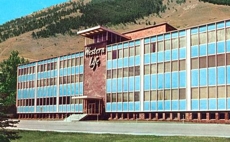
Western Life erected this familiar building at 600 N. Park Avenue from 1954-1956. The company vacated this location on August 17, 1961, moving to St. Paul, Minnesota. Forty-four Helena employess made the move with the company.


Full-page Independent Record newspaper ad for the open house at the new Western Life building, July 14 1956. Business had been transacted from the new building since June 17.


Branch office constructed on Park Ave. after the 1961 move to St. Paul.

In October of 1961, plans were announced for the construction of a Western Life branch office at 660 N. Park Ave., just north of the company's former building, which had been purchased by Mountain States Telephone. The new branch office was completed in the spring of 1962.


KXLJ-TV
2433 N. Montana Ave.
(now demolished)

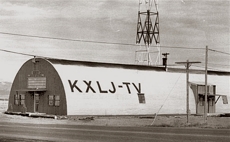
The KXLJ studios at 2433 N. Montana Avenue, about 1958. KXLJ (now KTVH) was the first television station in Helena, signing on the air January 1, 1958 as an NBC affiliate. The station was part of the "XL" Radio Network, along with stations KXLF Butte, KXXL Bozeman and KXLY Spokane, Washington. KXLJ radio (1240 AM) also had studios in this building, after being located in a log cabin at 1306 11th Ave. for many years.

Jan. 5 1958 newspaper ad for Sherman Music Co., Magnavox TV dealers. According to Bureau of Labor statistics, $219.50 in 1958 translates to about $2,100 in today's dollars -- about what you'd pay for a widescreen high-defintion set.

Not long after KXLJ-TV signed on in 1958, Bob Magnus and two partners bought the station and changed the call letters to KBLL-TV. In 1969, former Montana Governor Tim M. Babcock bought the station and changed the station's call letters to KTCM (Television for the Capitol of Montana). Babcock sold the station to Lynn Koch in 1979, and the station changed call letters again, this time to KTVG. A few years later, Koch sold the station to Don Bradley, who again changed the call letters to KTVH (TeleVision for Helena), which remain to this day. By 1988, the station was in financial trouble and Bradley sold it to Big Sky Communications. Big Sky Communications restored the station's financial health, and in 1997 sold KTVH to Beartooth Communications. (This info adapted from the Wikipedia entry about KTVH).

Long-time Helena broadcaster Wally Peel has put together an excellent history of KXLJ, for the KTVH website. Click here to visit!


COURTESY OF WALLY PEEL

The site of KXLJ-TV, 2007. The Checker Auto Parts store is on the exact location.


LUNDY'S SUPERMARKET
300 Euclid Ave. at N. Benton Ave.

Lundy's expanded market, NW corner of Euclid and Benton, 1950.

Lundy's was a small Montana grocery chain headquartered in Helena. It was owned by Oliver and Albert Lundborg, and operated from the 1930s to the 1960s with stores in Helena, Townsend and Livingston.

Albert (1914-2005) and Oliver Lundborg (1912-2006) were natives of South Dakota, where their father had a general store in Alpina. Their sister Elsie had come to Helena, and was working at Intermountain College. Al and Oliver later came west, and enrolled at Intermountain.

The closing of the school after the earthquakes of 1935 sent Al back to South Dakota, where he earned a degree in accounting and economics. He returned to Helena, and along with Oliver opened Lundy's Drive-In Market at the corner of Montana Ave. and 11th. in 1939.

World War II interrupted their endeavors, closing the store for a time. in 1946, Al and Oliver purchased several lots on the NW corner of Benton and Euclid and built a new Lundy's Market there. In 1950, they expanded the store into what was Helena's first "supermarket". Other family members had by then joined the enterprise.

The expanded store, the entrance of which is shown in the rather poor-quality image above, measured 140' x 75' (10,500 sq. ft.). The parking lot had spots for 300 cars. The interior was lit by three rows of flourescent lights, and featured self-service meat and produce counters.

The Lundborgs ran their own produce trucks between Montana and the west coast, which they claimed enabled them to stock better produce at lower prices than their competitors. The supermarket was extensively remodeled in 1954.

In 1963, the Lundborgs sold the food market interest to Super Save Markets and built the Lundy Center. The old store closed on Nov. 9, 1963, and was moved south across Euclid Avenue, where it today houses the Crossroads Sports and Fitness Club.

Al operated the Lundy Center for twenty years before selling it, and began devoting much of his time to the Helena community, especially to the arts.


COURTESY OF CATHEE CRAPO

The new Lundy Center under construction, 1964. The old market can just be seen on the far right.


STEWART HOMES
N. Montana Ave. and Butte. Ave.
1940 - Today
Public housing project -- named for enemy of free speech


COURTESY OF TOM KILMER

Stewart Homes, winter 1967. Photo taken from the porch of 309 Stewart Homes. This FHA housing project on Montana Avenue first opened in 1940 with 72 units; 60 more units were added in 1953. The project was named for Montana Supreme Court Associate Justice Samuel V. Stewart (1872-1939). A Democrat, Stewart also served as Governor of Montana from 1913 to 1921. The project was ostensibly named for him because he was instrumental in upholding the constitutionality of the Federal Housing Administration, but Stewart's ultimate legacy is that of an enemy of free speech...

In 1918, Governor Samuel V. Stewart, for whom Stewart Homes is named, enacted the Montana Sedition Act, which has been called the broadest, most repressive anti-speech law passed by a state in the history of the country. The law applied to anyone who in wartime spoke or published “disloyal, profane, violent, scurrilous, contemptuous, slurring or abusive language about the form of government of the United States.”

The accused could then be convicted of sedition at trial, sent to prison for up to 20 years and fined up to $20,000. Of the 145 people charged, 78 were convicted. Of those convicted, 41 were imprisoned.

In May of 2006, thanks to the efforts of those involved in the Sedition Project of the University of Montana's School of Journalism, Governor Schweitzer signed a Proclamation of Pardon for 78 persons convicted of sedition in 1918-1919.


COURTESY OF TOM KILMER
The Kilmer family, Stewart Homes, 1959.


SUNNY-VIEW GUEST HOME
706 Cannon

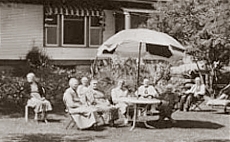
The Sunny-View Guest Home, 706 Cannon, 1950s. From their 1953 Yellow Pages ad..."Permanent Home for the Aged. Convalescents Cared For. Registered Nurses on 24-Hour Duty. Jean N. Cirica, R. N., Supt.". Nurse Cirica was from Idaho, and lived 1885-1970.


HI-WAY MARKET
FORMERLY CRAMER'S TRADING POST

916 Poplar at N. Montana Ave.
"Located out of the high rent district."

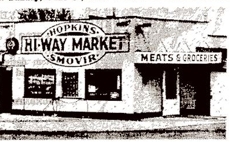
The Hi-Way Market was a handy stop on the way to Canyon Ferry or Lakeside. The combination market and service station was opened in 1936 by Arthur Cramer as Cramer's Trading Post. Cramer also operated a livestock auction, held south of the market on National Avenue. There was also a small trailer park north of the market.

Jimmy Hopkins and John Smovir took over in 1949. The store closed early in 1970. If anyone has actual photos of the operation, please let me know.


LINDY'S PARCHEN DRUG
Horsky Block, Sixth and Main
Built in 1884 - destroyed by fire in 1980

Pictured above is the H. M. Parchen Co. at 1 South Main, about 1893. Prussian native Henry M. Parchen was the first wholesale druggist in Montana, and a noted civic leader in early Helena.

Parchen opened the doors of the first drug store in the state in a building at the corner of Wood and Main streets in 1865. Prior to that, he had conducted a general merchandise business at
Virginia City and at Deer Lodge.

Business in Helena grew rapidly. Parchen moved his store to a building at the foot of Broadway, but it was soon found to be inadequate, and a second move was made to the location across the street at 1 South Main.

In 1921, Parchen sold the retail drug business, along with the use of the trusted Parchen name, to George W. Padbury. It appears from newspaper archives that Parchen's Drug Store moved from the Broadway location and opened in the Horsky Block, at the corner of Sixth and Main, in 1924.

In October of 1954, Fred Padbury (1894-1961) sold Parchen's to C. Douglas Lindeberg (1916-1988) , who renamed the concern "Lindy's Parchen Drug".

The following 1950s photos of Lindy's Parchen Drug are courtesy of Bob and Susie Lindeberg...


COLLECTION OF BOB & SUSIE LINDEBERG
Lindy's Parchen Drug in the Horsky Block, mid 1950s.


COLLECTION OF BOB & SUSIE LINDEBERG
Magazine racks in Lindy's


COLLECTION OF BOB & SUSIE LINDEBERG
Lindy's Parchen Drug, with the old tin ceiling in place.


COLLECTION OF BOB & SUSIE LINDEBERG
Hair care department. Note the marble bases on the showcases.


COLLECTION OF BOB & SUSIE LINDEBERG
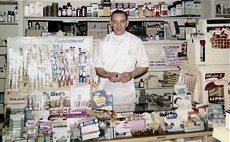
Pharmacist and owner C. Douglas Lindeberg


COLLECTION OF BOB & SUSIE LINDEBERG
Honeycomb tissue-paper bells at the holidays.


On April 2, 1959, this ad appeared in the Independent Record announcing Parchen's remodeling sale. A new floor and fixtures greeted the eager customers. There were merchandise giveaways, and a contest to win a 32-piece set of stainless steel dinnerware by guessing how many aspirin tablets were contained in "The world's largest bottle of aspirin", which was on display. There were also demonstrations of a Keystone home movie camera...


COLLECTION OF BOB & SUSIE LINDEBERG
Helenans crowd in for the Grand Opening festivities...


COLLECTION OF BOB & SUSIE LINDEBERG


COLLECTION OF BOB & SUSIE LINDEBERG
Remodeling Sale customers browse the shelves. Note the many flower arrangements.


COLLECTION OF BOB & SUSIE LINDEBERG
The new floor and fixtures...


COLLECTION OF BOB & SUSIE LINDEBERG


COLLECTION OF BOB & SUSIE LINDEBERG
Product demonstrators. The big bottle of aspirin is on the right.


COLLECTION OF BOB & SUSIE LINDEBERG
Probably a prize drawing.


COLLECTION OF BOB & SUSIE LINDEBERG
A color view of the aspirin bottle. On the left, behind the counter, is Marjorie Shafer Lindeberg.


COLLECTION OF BOB & SUSIE LINDEBERG
Douglas Lindeberg behind the counter.


COLLECTION OF BOB & SUSIE LINDEBERG
Douglas and Marjorie Lindeberg.


COLLECTION OF BOB & SUSIE LINDEBERG
Constitution Park, 2007. The site of the Horsky Block and Lindy's Parchen Drug


SCOTT'S TOYS
112 E. 6th Ave. (1951-1954) • 313 North Main (1954-1957)


COLLECTION OF KENNON BAIRD

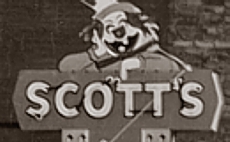
Scott's Toys at 313 North main St., 1954. This small brick building had previously housed the Hambuger Inn (late 1920s) and International Business Machines (late 1940s). It was demolished to make way for the 1st National Bank Motor Bank, which opened in October of 1958. The footprint of the building is seen on the locator map below...

Scott's Toys was operated by Lyman H. Scott (birth/death unknown) from 1951 until 1957. The enterprise opened at 112 E. 6th. Ave in 1951, then relocated to 313 N. Main in 1954.


COLLECTION OF KENNON BAIRD

After closing the toy store in 1957, Lyman Scott went into the water-softening business.


THE HUSTAD SHOPPING CENTER
1088 Helena Ave.

The Hustad Center is still in business at 1088 Helena Avenue. It opened in the fall of 1956. During the 1950s-60s, it was home to Buttrey Foods, Super Save Drugs, Marshall-Wells, a laundromat, a shoe repair shop, a candy store, a bakery and other enterprises. There was a small Little Chief gas station on the east side of the lot. If you have a better vintage image of the center, please let me know.


Two-page Independent Record display ad for Buttrey Food's grand opening in the Hustad Center, Oct. 31, 1956. Prior to moving to the Hustad Center, Buttrey's was located at 13th and Jackson.


COURTESY OF THE BISOM FAMILY CLICK ON THE IMAGE FOR A LARGER VIEW

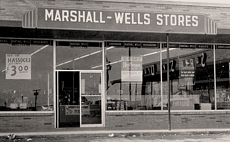
The Marshall-Wells store in the Hustad Center opened on Nov. 1, 1956. Marshall-Wells was a Michigan-based hardware concern, which at its peak in the mid-1950s serviced approximately 900 independently-owned retail stores bearing the Marshall-Wells name, and 6,000 independent dealers.

The Helena store was in business from November of 1956 to December of 1966. It was owned and operated by William & Barbara Bisom.


Independent Record display ad, Super Save Drug, Nov. 9, 1956


The Super Save Drug sign, reflected in Marshall-Wells' window.


Little Chief Gas logo.


CAPITAL HILL SHOPPING CENTER
11th Ave. between N. Roberts and N. Oakes

HELENA'S FIRST MALL -- OPENED MARCH 4, 1965

Independent Record tabloid section, Feb. 28 1965.


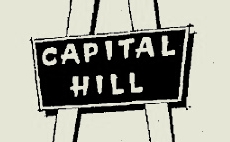
The design of the first Capital Hill Shopping Center sign was pure 1965.


Capital Hill Shopping Center store guide, Feb. 28 1965
1. Hennessy's Store 7. Hal Wheat Real Estate and Insurance